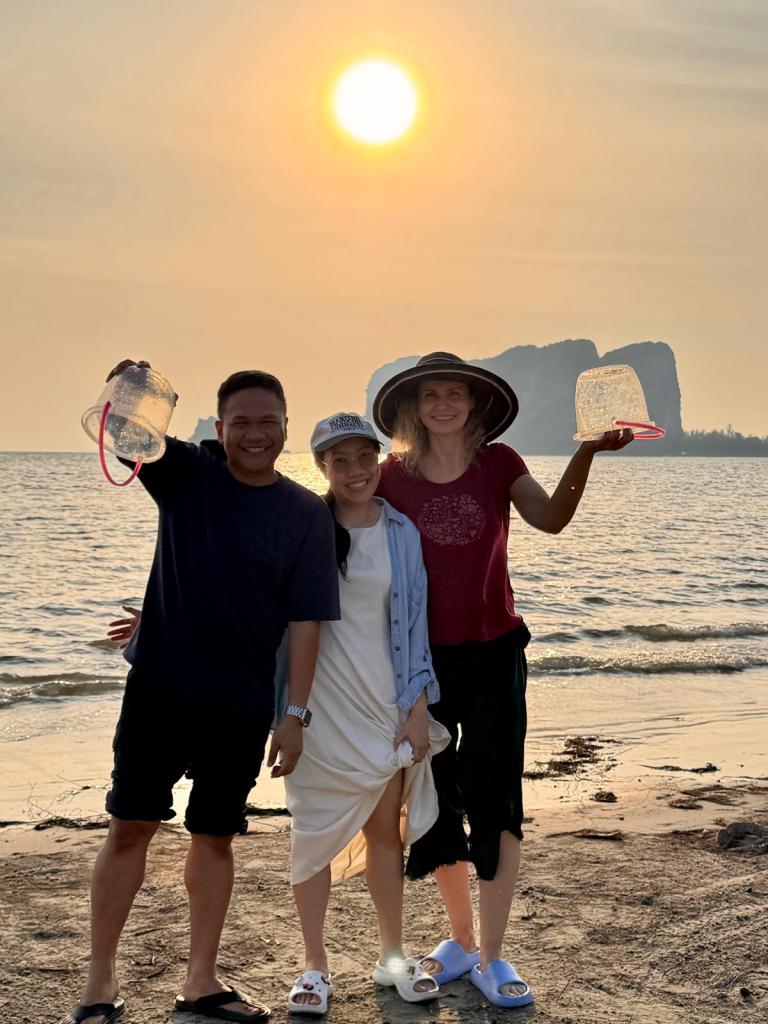
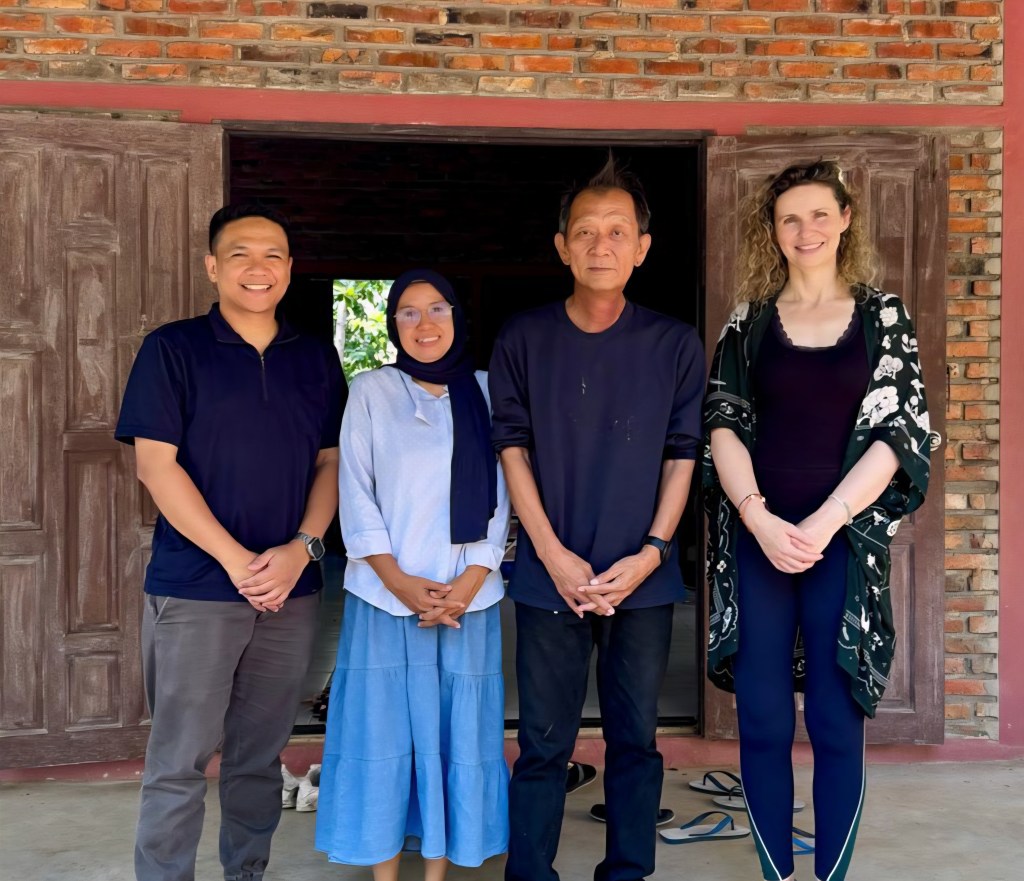
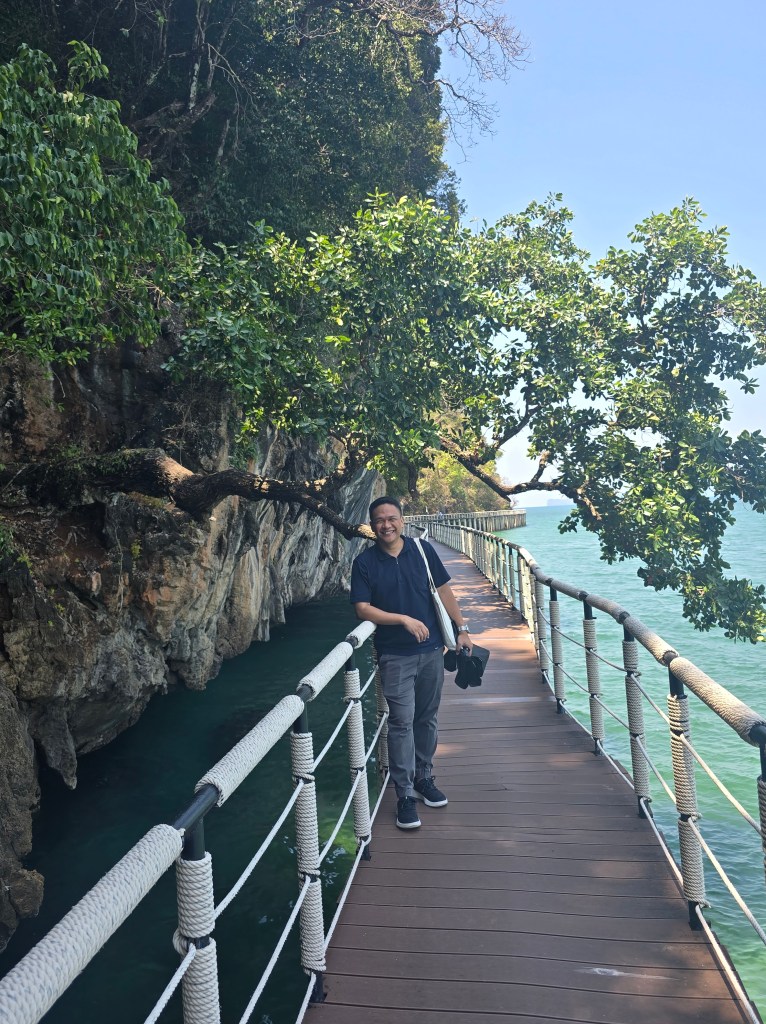
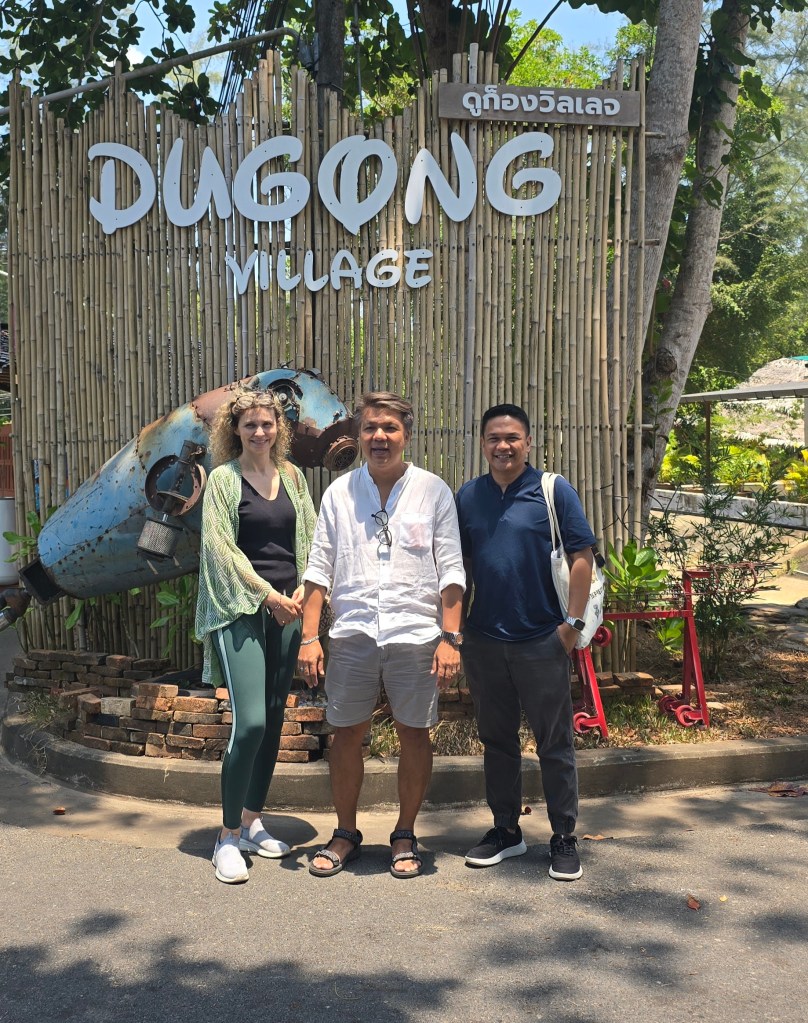
Fieldwork: Michelle Miller and Jay Quevedo undertook fieldwork in Trang Province, Thailand, from 22-28 March 2026.
CGSEA researchers Michelle Miller and Jay Quevedo undertook fieldwork in Trang Province, Thailand, from 22–28 March 2026. They conducted 15 interviews on seagrass governance in the reigon, including with representatives from provincial and municipal-level government agencies, heads of villages and community-based groups, academics, private actors, and local and international NGOs.
Click here to learn more about CGSEA’s work on Coastal and Freshwater Ecosystems.
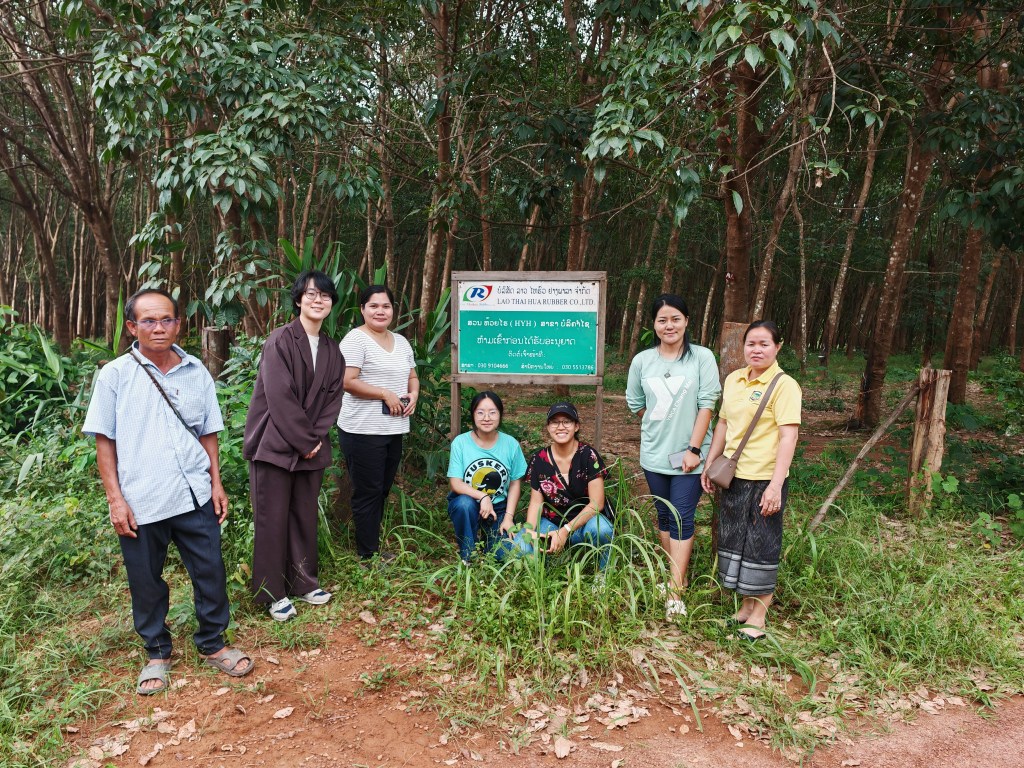
Announcement: Happy World Forest Day from CGSEA! 🌲 (21 March)
Forests are essential for life on Earth, supplying oxygen, shelter, food, water & fuel. As vital engines in a sustainable bioeconomy, forests provide forestry-related jobs, support agriculture, & protect the health of watersheds.
The CGSEA team respects the important role that Indigenous Peoples & local communities play in stewarding the world’s intact forests, as we investigate how forests in Southeast Asia are used as instruments for mitigating climate change, & the sociopolitical issues associated with this. Our preliminary analyses reveal a dynamic setting of institutional capacity-building & legislative reviews, as actors in the region negotiate how engaging with carbon markets can be done in ways that benefit Indigenous Peoples and local communities.
Click here to learn more about CGSEA’s work on Terrestrial Forests.
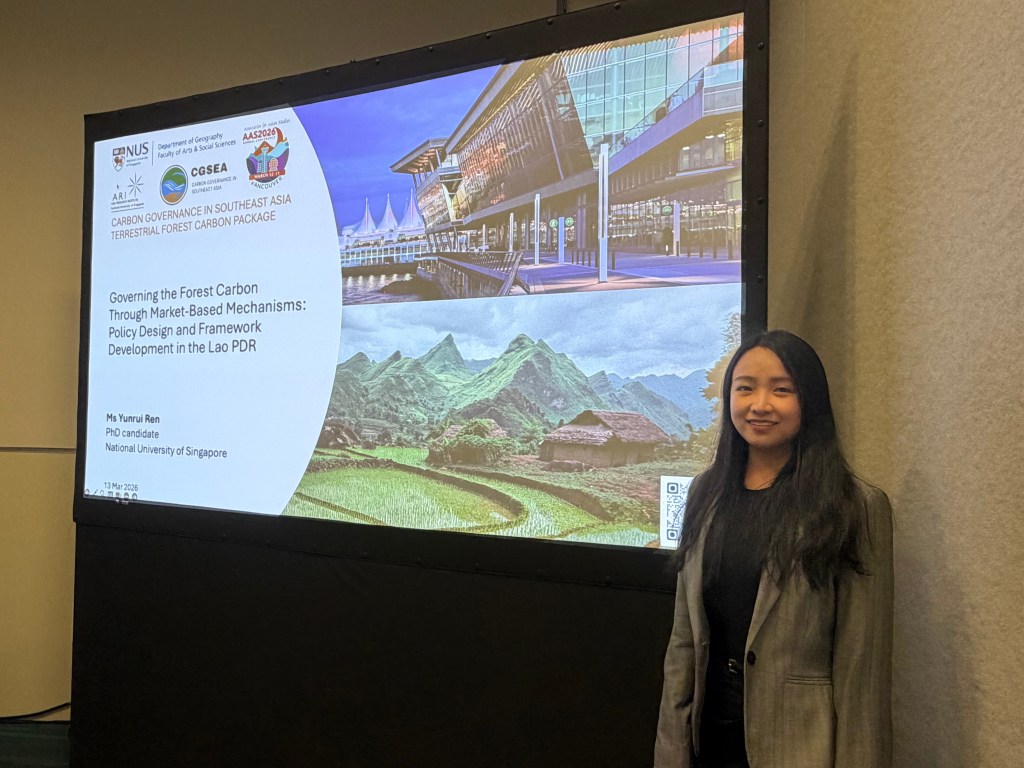
Presentation: Ren Y (2026) Financialization of forest carbon: Financial instruments, infrastructures, and governance. 2026 AAG Annual Meeting, Organised by the American Association of Geographers, online, 19 March; Ren Y (2026) Governing the Forest Carbon Through Market-Based Mechanisms: Policy Design and Framework Development in the Lao PDR. 2026 AAS Annual Conference, Organised by the Association of Asian Studies, Vancouver, Canada, 13 March.
PhD Candidate Yunrui Ren, based at the Department of Geography, National University of Singapore, and attached to the CGSEA grant, has had a busy March, presenting at the Annual Meetings of both the Association for Asian Studies and American Association of Geographers on 13 and 19 March respectively.
For AAS 2026, Yunrui delivered a talk titled “Governing the Forest Carbon Through Market-Based Mechanisms: Policy Design and Framework Development in the Lao PDR”, in-person in Vancouver, presenting snippets from her PhD fieldwork in Laos from July-December 2025. For AAG 2026, Yunrui shared a specific thread of her ongoing work, reflecting on the “Financialization of forest carbon: Financial instruments, infrastructures, and governance”, online.
Ren’s work is part of CGSEA’s work package on Terrestrial Forests, and studies the challenges and insights arising from the deployment of market-based mechanisms for forest carbon governance in Laos.
Click here to learn more about CGSEA’s work on Terrestrial Forests, which Lau contributes to.
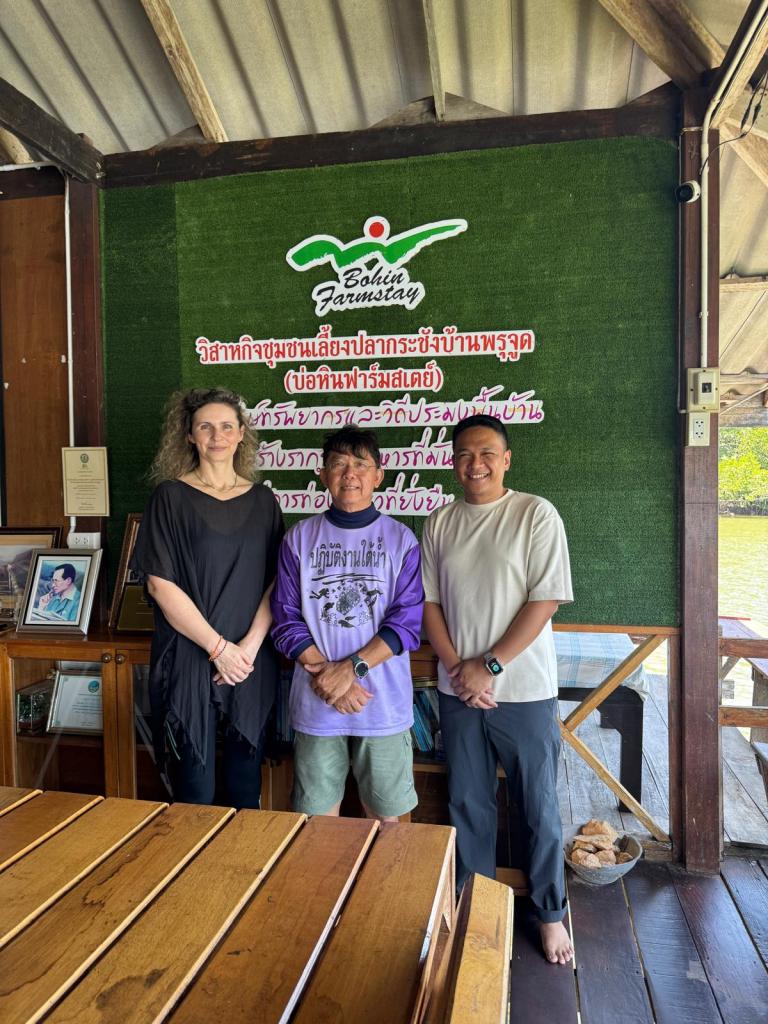
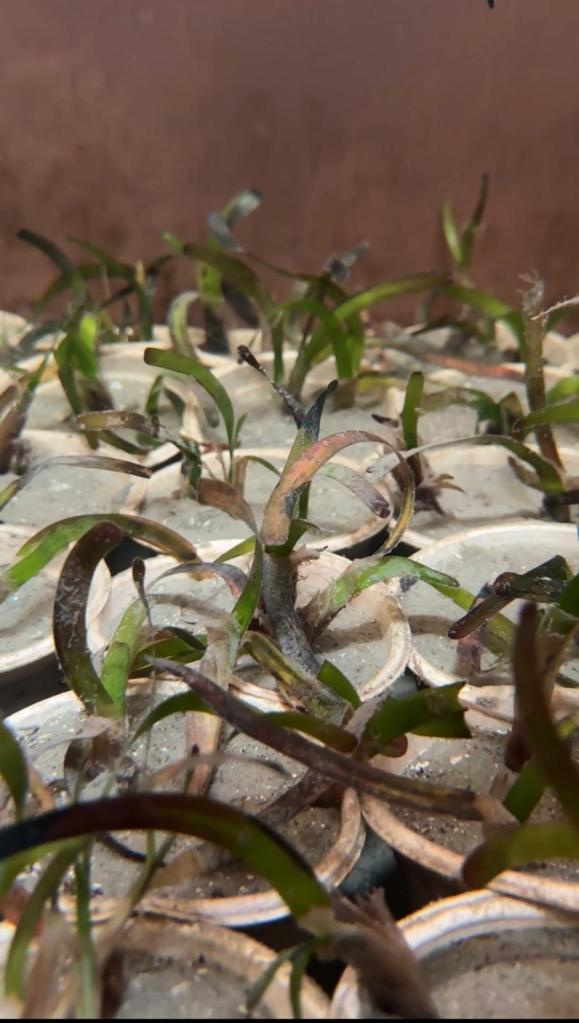
Announcement: Happy World Seagrass Day from CGSEA! 🌱 (1st March)
Our project’s team working on Coastal and Freshwater Ecosystems conducts research on the important and diverse ecosystem services provided by seagrasses around Southeast Asia.
Click here to learn more about CGSEA’s work on Coastal and Freshwater Ecosystems.
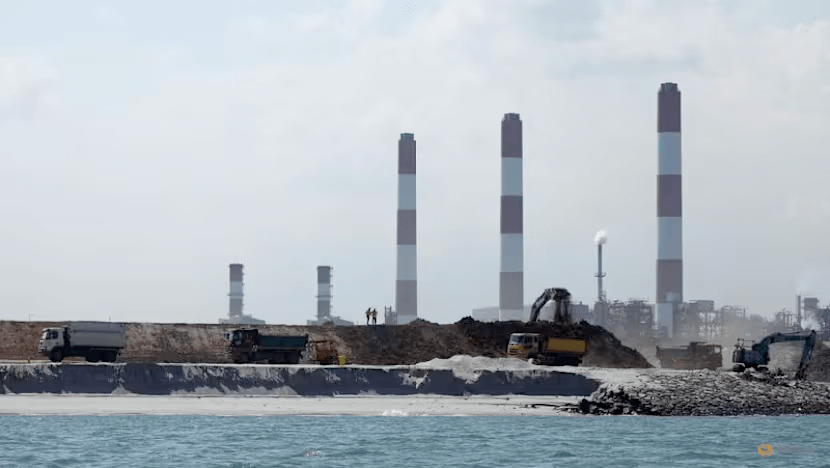
Opinion Piece: Low M (2026) Commentary: Budget 2026 – less ambitious carbon tax comes with tradeoffs for Singapore. Channel News Asia, 16 February.
Melissa Low authored an opinion piece for Channel News Asia titled ‘Commentary: Budget 2026 – less ambitious carbon tax comes with tradeoffs for Singapore.’
Low argued that while a less ambitious carbon tax policy could enhance competitiveness, it would reduce the urgency for companies to decarbonise or purchase high-quality carbon credits to offset emissions. She opined that, instead of lowering its carbon pricing ambitions, Singapore could ‘extend existing transitory allowances to help carbon-intensive industries defray rising costs’.
Click here to read the full opinion piece.
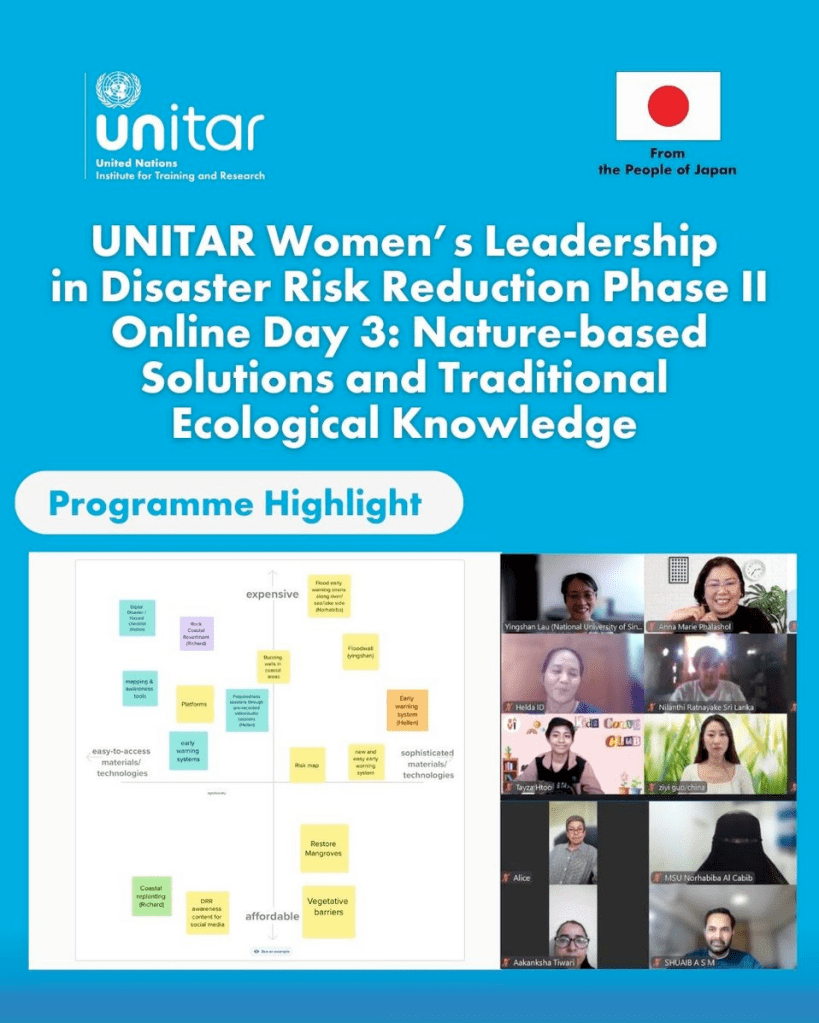
Presentation: Lau Y (2026) Nature-based Solutions and Traditional Ecological Knowledge. Invited presentation, Organised by the United Nations Institute for Training and Research (UNITAR), online, 10 February.
CGSEA researchers regularly contribute to capacity building efforts in the Southeast Asia region and beyond. Research Fellow Yingshan Lau recently delivered an expert session titled ‘Nature-based Solutions and Traditional Ecological Knowledge’ for a United Nations Institute for Training and Research (UNITAR) programme on Women’s Leadership in Disaster Risk Reduction, on 10 February 2026.
Lau shared insights from her research and fieldwork, and then hosted a discussion where selected participants presented work developed through previous phases of the programme.
Click here to learn more about CGSEA’s work on Terrestrial Forests, which Lau contributes to.
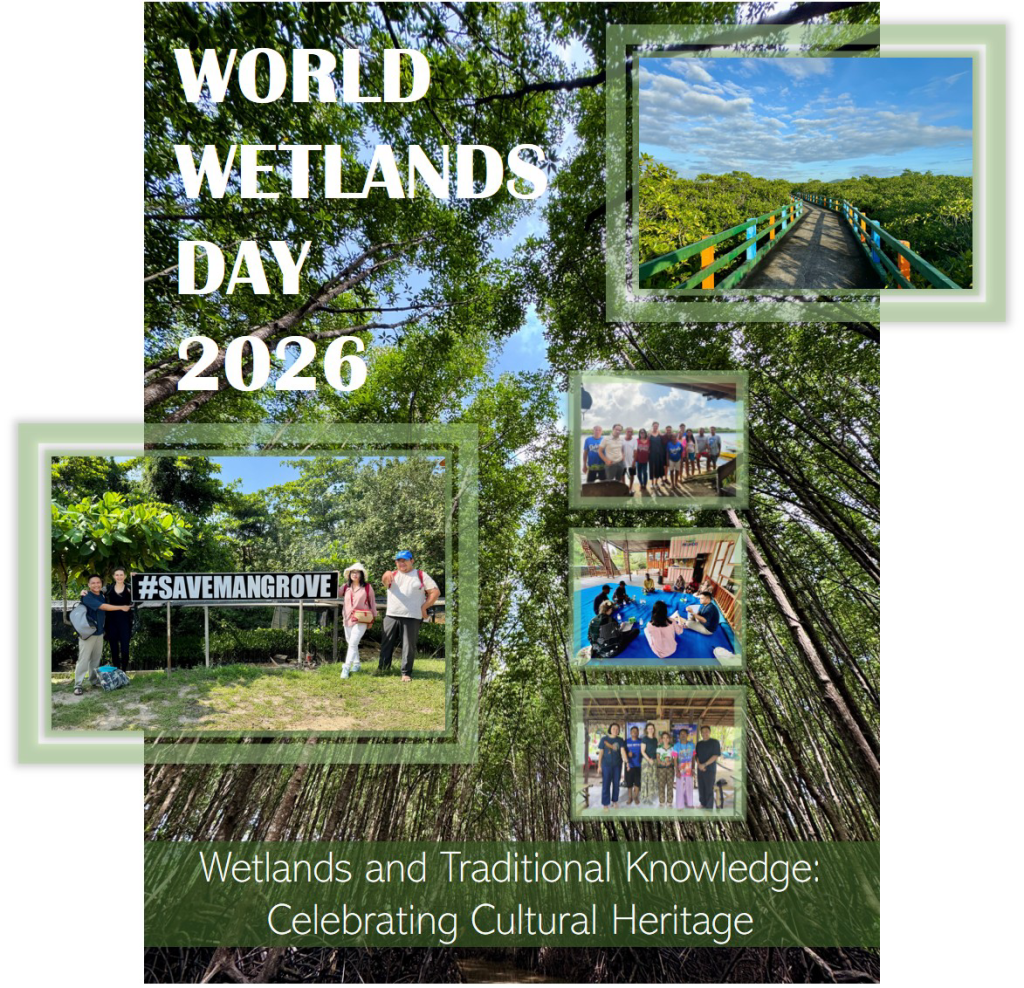
Announcement: Happy World Wetlands Day from CGSEA! 💧🌿 (2nd February)
Happy World Wetlands day from the CGSEA team!
Wetlands are among the most vital ecosystems on Earth. Beyond serving as natural buffers and climate defenders, they are living reservoirs of traditional knowledge, passed down through generations. Through the CGSEA project, we stand with communities in recognizing wetlands as spaces where culture, knowledge, and nature intersect.
Our Work Package 2 team examines wetland governance with a focus on blue carbon ecosystems. Our preliminary analyses—drawn from interviews and focus group discussions—show that wetlands function as knowledge hubs for local communities, shaping stewardship, livelihoods, and decision-making.
Stay tuned for our upcoming papers as we continue to unpack these insights!
Click here to learn more about CGSEA’s work on Coastal and Freshwater Ecosystems.
2025
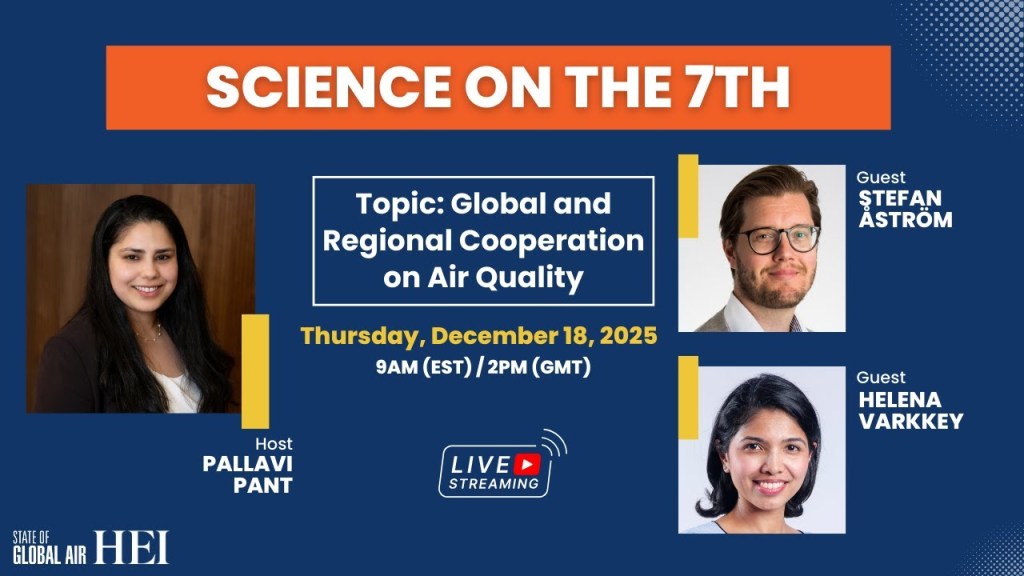
Media mention: (2025) Global and Regional Cooperation on Air Quality. State of Global Air, 18 December.
Helena Varkkey was an invited guest commenting on Global and Regional Cooperation on Air Quality for State of Global Air’s Science on the 7th interview series, where she shared her expertise on the causes and environmental effects, as well as the politics and regulation of, transboundary haze in Southeast Asia.

Media mention: (2025) SE Asia forest carbon projects sidelining social, biodiversity benefits, study finds. Mongabay, 1 December.
Yingshan Lau was interviewed by Mongabay for a feature on her lead-authored review paper on ‘Challenges in Forest Carbon Governance: Insights From Southeast Asia’, co-authored with other researchers from the project’s team working on Terrestrial Forests.
The article explored how forest carbon projects across Southeast Asia are falling short on social justice safeguards due to weak governance, land tenure conflicts, corruption, and fragmented policies, and echoed expert concerns for more scrutiny and accountability of these projects.
It also echoed CGSEA researchers’ conclusion that well-managed forest carbon initiatives are important to reduce emissions, but must center the rights of local and indigenous communities.
Mongabay staff writer Carolyn Cowan supplemented the paper’s findings with Lau’s expert opinion, drawing from her work with local and indigenous communities in Laos.
Click here to read the full feature.


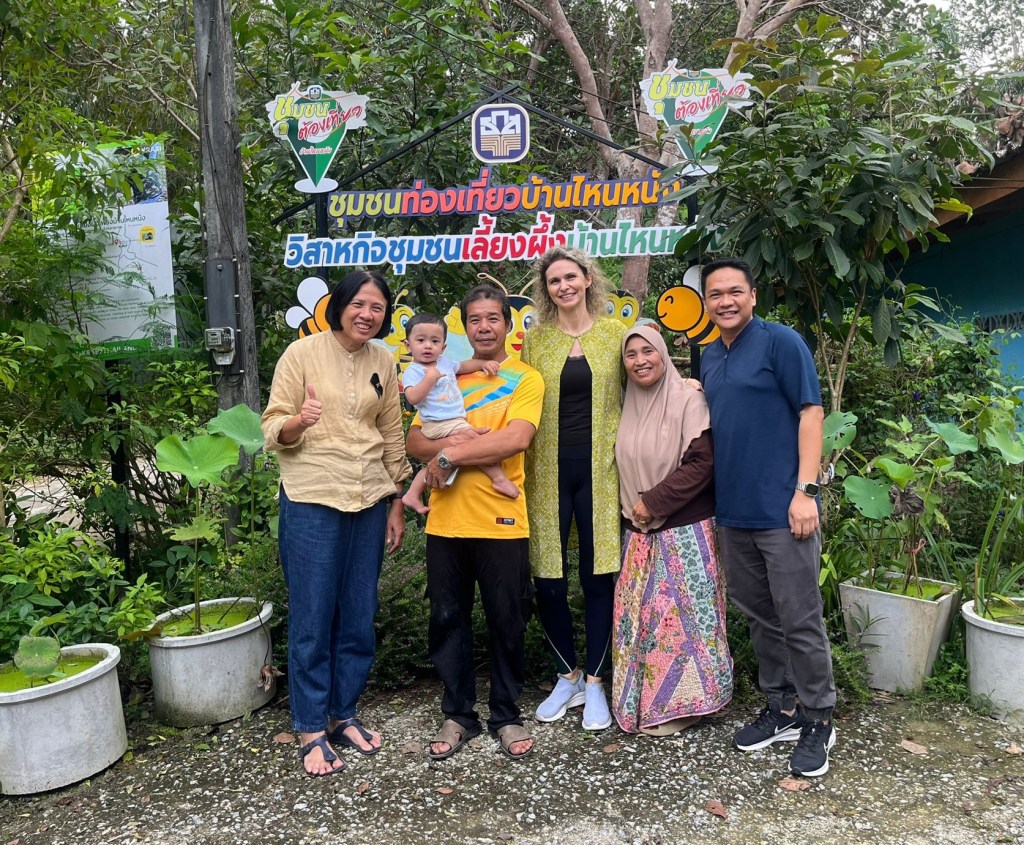
Fieldwork: Michelle Miller and Jay Quevedo undertook fieldwork in Krabi Province, Thailand, from 23-30 November 2025.
The researchers conducted 17 interviews about seagrass and mangrove governance in Krabi Province, Thailand, with diverse stakeholders (representatives from different government departments, farmers, fishers, apiarists, community representatives, scientists—including marine biologists and citizen scientists—and carbon credit groups).
This fieldwork was conducted as part of an interdisciplinary effort by the project’s work packages on Coastal and Freshwater Ecosystems and Technologies and Social Relations.

Presentation: Gevaña D (2025) Mangrove conservation promoting sustainable ecotourism and local livelihoods. Invited plenary speaker for the 3rd International Conference on Biodiversity and Sustainable Development 2025, Organised by Universiti Teknologi Mara, Langkawi, Malaysia, 28 November.
Dixon Gevaña was invited to give a plenary talk on ‘Mangrove conservation promoting sustainable ecotourism and local livelihoods’ at the 3rd International Conference on Biodiversity and Sustainable Development 2025.
Gevaña is a part of the project’s Work Package on Coastal and Freshwater Ecosystems, where he investigates the economic—including ecotourism—potential of Blue Carbon projects for local communities, through the lens of environmental governance.

Presentation: Varkkey H (2025) Knowledge Co-Creation with Peatland Communities for Improved Peatland Governance. Invited speaker for Peatlands Futures: Integrating Data and Community Governance for Nature-Based Climate and Haze Solutions, organised by the Institute for Southeast Asian Studies (ISEAS), Singapore, 24 November.
Helena Varkkey was invited to speak on ‘Knowledge Co-Creation with Peatland Communities for Improved Peatland Governance’ for a hybrid seminar organised by the Institute for Southeast Asian Studies (ISEAS).
In addition to delivering her talk, Varkkey also launched a policy brief on community-centred actions for improved peatland governance and the implementation of nature-based solutions (NbS), which she led the writing of.
Click here to learn more about the seminar.
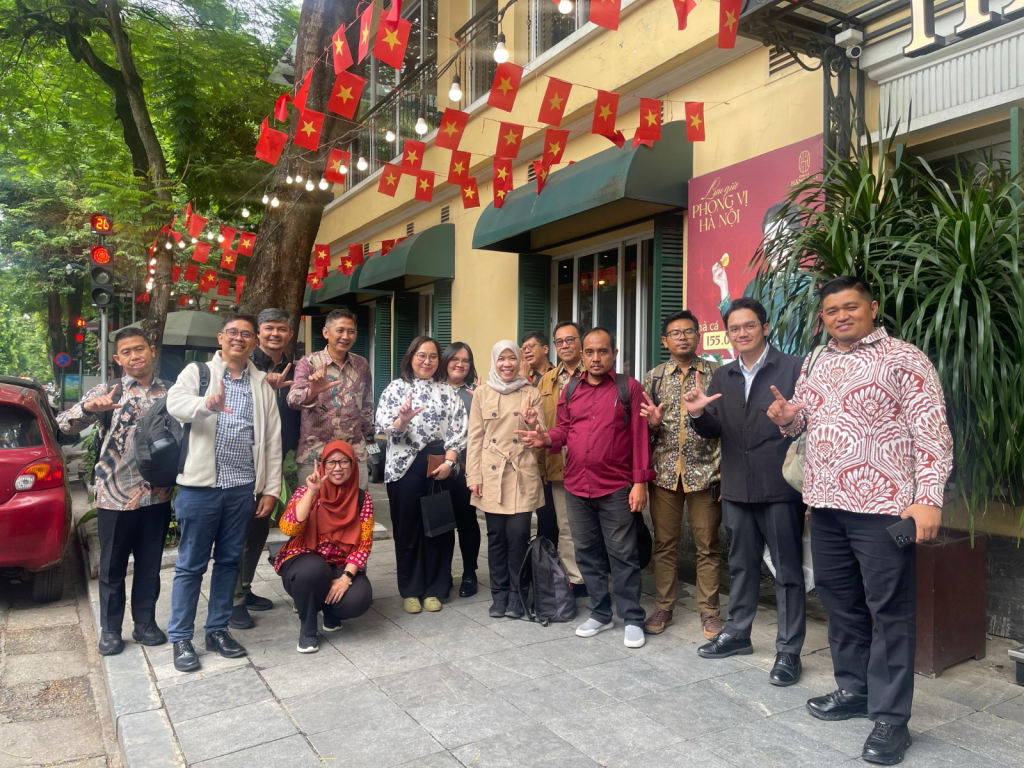

Announcement: Prayoto Tonoto was invited to participate in a Bilateral Exchange between the Government of Indonesia and the Government of Vietnam, in Hanoi, Vietnam, on 3-6 November 2025.
The forum, organised by the United Nations Environment Programme (UNEP), aimed to exchange learnings and experiences on forest carbon markets and Article 6 implementation between Indonesia and Viet Nam, including the role of Article 6.2 cooperative approaches, potential participation in Article 6.4 and linkages with voluntary carbon market standards and strengthen institutional and technical networks between Indonesian and Vietnamese counterparts.
Tonoto, who is a member of the project’s Work Packages on Coastal and Freshwater Ecosystems and Peatlands and Agricultural Soils, was invited to participate in this exchange in his capacity as Environmental Extension Officer and Associate Expert at the Department of Enviornment and Forestry Service for the Riau Province in Indonesia.

Announcement: Danny Marks and Janice Lee have been appointed Lead Authors for Working Group II (Impacts, Adaptation and Vulnerability) of the Intergovernmental Panel on Climate Change’s (IPCC) Seventh Assessment Report (AR7).
The Intergovernmental Panel on Climate Change (IPCC) has appointed 664 experts from 111 countries to participate in AR7 as Coordinating Lead Authors, Lead Authors and Review Editors. These experts were nominated by governments and IPCC observer organisations and selected by the IPCC Bureau from a global pool of 3,771 nominees. The AR7 report is one of three working group contributions to the overall IPCC assessment, which will be published in 2029.
Marks, who is part of the project’s Work Packages on Coastal and Freshwater Ecosystems and Systems, Technologies and Social Relations, has been appointed Lead Author for Chapter 8: Asia. Lee, who contributes to the project’s Work Package on Terrestrial Forests, will serve as Lead Author for Chapter 14: Terrestrial, freshwater and cryospheric biodiversity, ecosystems and their services.
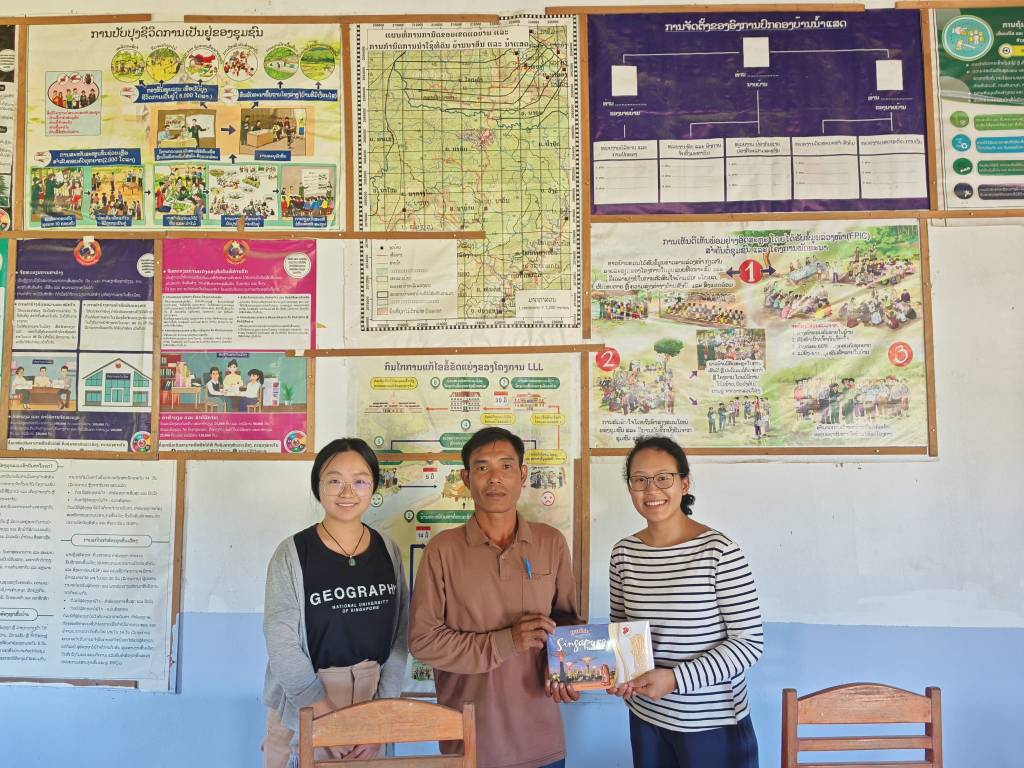
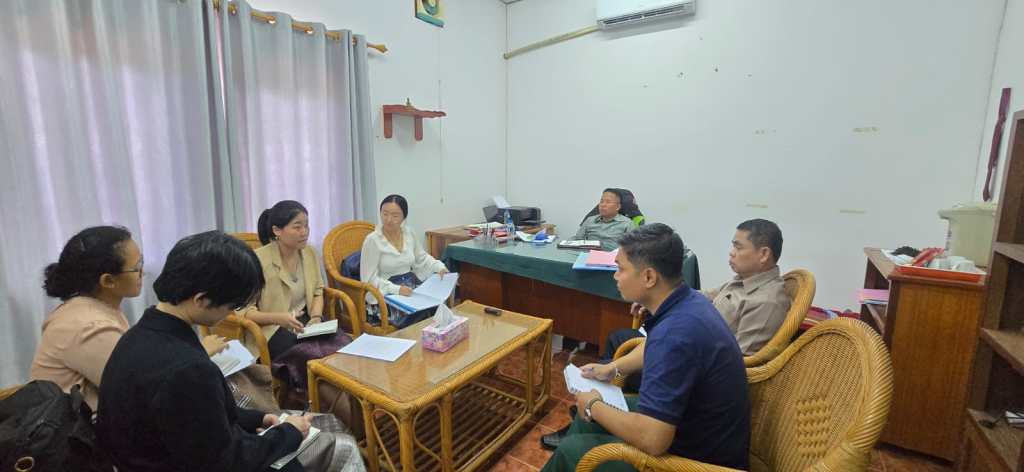
Fieldwork: Yunrui Ren and Shakura Bashir undertook fieldwork at a forestry project site in Laos from 26 October-3 November, 2025.
CGSEA PhD Student Yunrui Ren and PhD affiliate Shakura Bashir conducted surveys and focus group discussions with various respondents at the Burapha Afforestation, Reforestation and Revegetation (ARR) site in Laos.
They collaborated with two Research Assistants and a faculty member from the National University of Laos, as well as an official from the local District Agriculture and Forestry Office. CGSEA signed an MOU with the National University of Laos in 2023, as part of efforts to establish research networks in the project’s field sites around Southeast Asia, ensuring that our research activities can be facilitated by local partners. This fieldwork was conducted as part of the project’s work package on Terrestrial Forests, and feeds into Ren and Bashir’s respective PhD research.
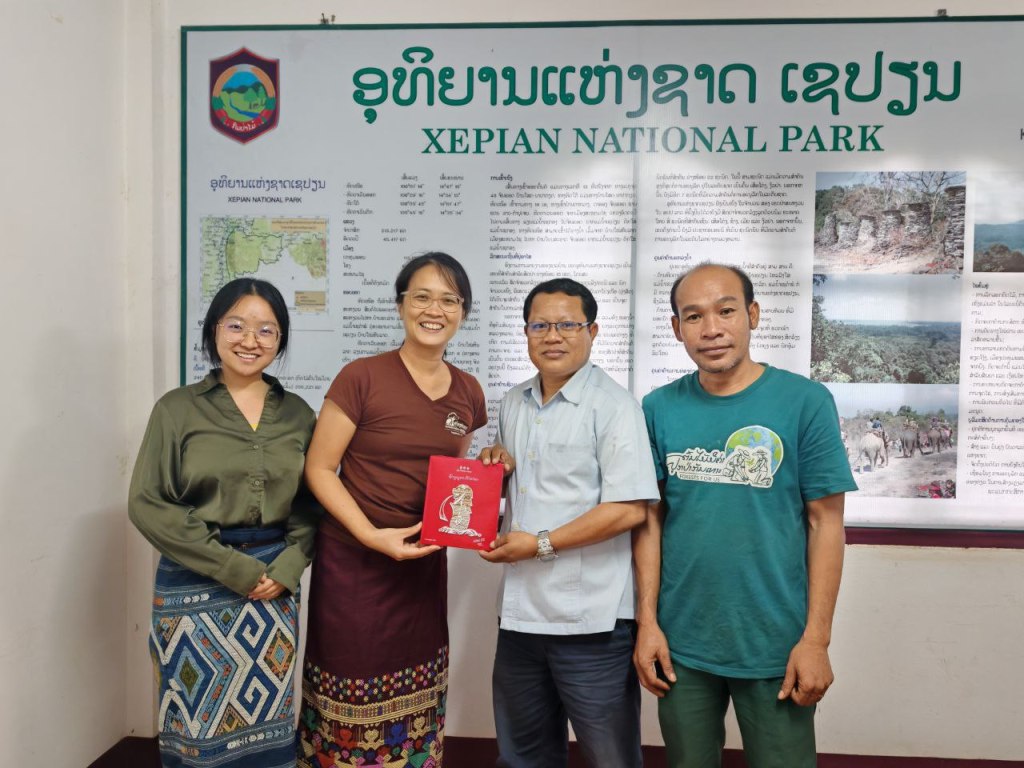
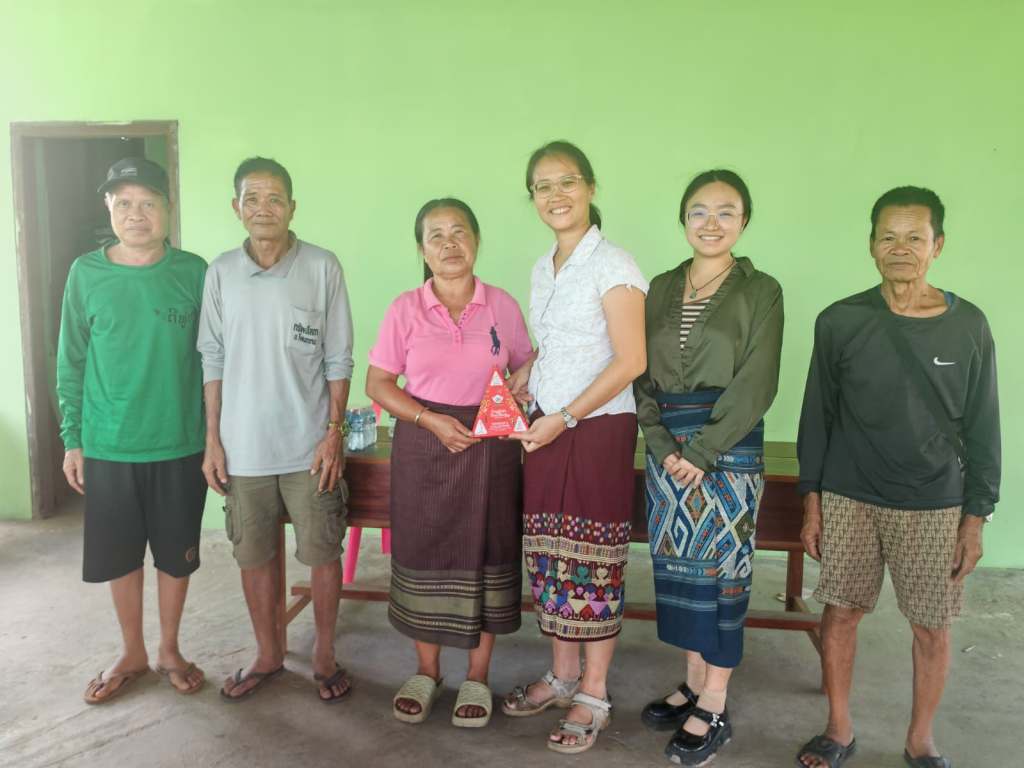
Fieldwork: Yingshan Lau and Yunrui Ren undertook fieldwork at the Xe Pian National Park REDD+ project site in Laos from 14-16 October, 2025.
Yingshan Lau and CGSEA PhD Student Yunrui Ren visited the Xe Pian National Park REDD+ project site as part of ongoing research on the forest carbon landscape in Laos. They visited the Provincial Agriculture and Forestry Office, the Xe Pian National Park Office and involved villages, speaking to relevant stakeholders at each site.
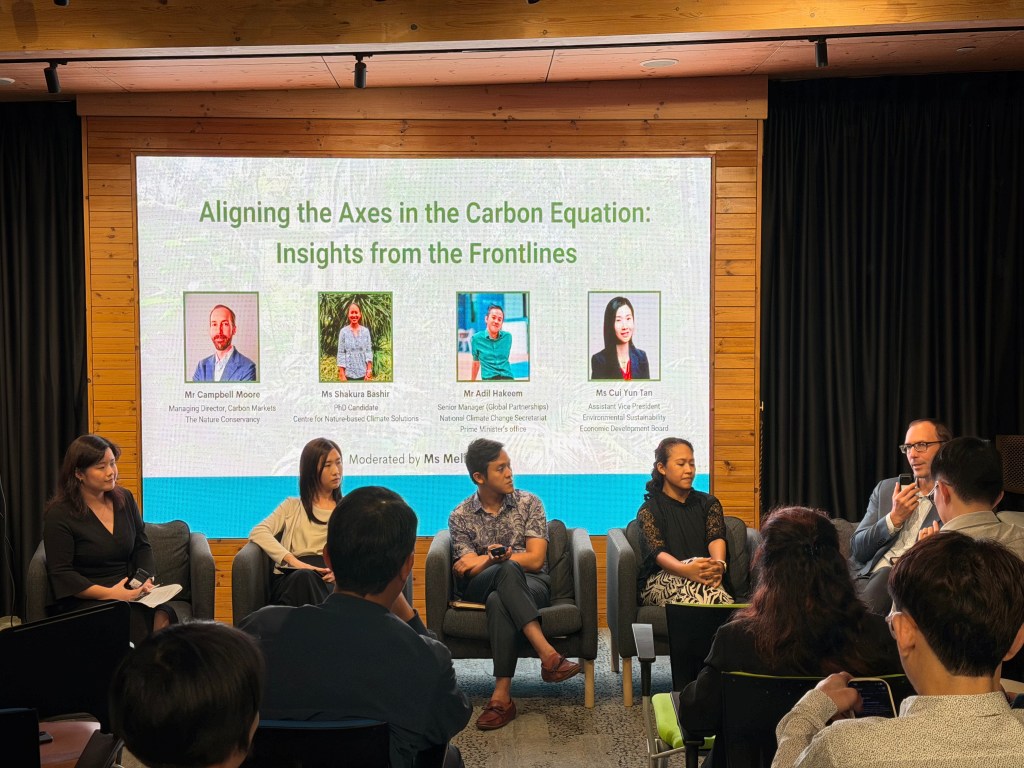
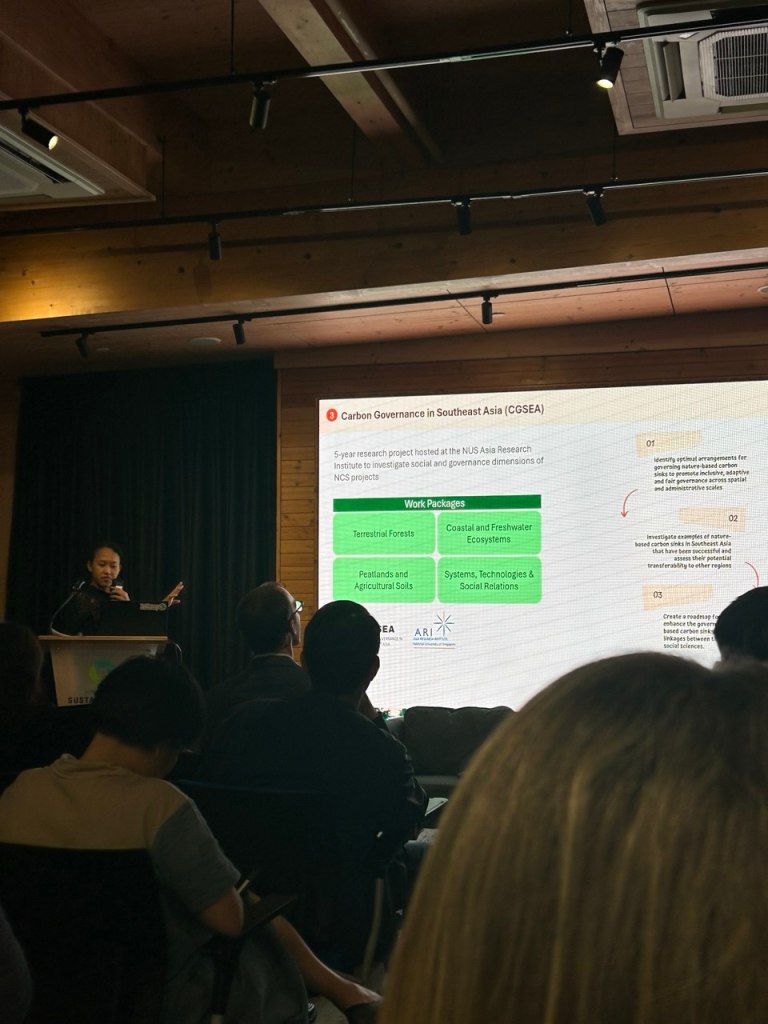
Presentation: Bashir S (2025) Beyond Carbon: Towards a Holistic Assessment of Integrity and the Role of Governance. Invited speaker for Getting Ahead of the Carbon Curve, Co-organised by the Centre for Nature-based Climate Solutions, NUS Sustainability Academy, and The Nature Conservancy, Singapore, 15 October.
Shakura Bashir was invited to speak on ‘Beyond Carbon: Towards a Holistic Assessment of Integrity and the Role of Governance’ at Getting Ahead of the Carbon Curve, an event co-organised by the Centre for Nature-based Climate Solutions at NUS, the NUS Sustainability Academy, and The Nature Conservancy, on 15 October.
Bashir shared insights from her fieldwork in Laos, conducted as part of her ongoing PhD research, some of which was conducted alongside CGSEA PhD Student Yunrui Ren. Bashir also served on a panel alongside Ms Tan Cui Yun from the Economic and Development Board, Singapore, Mr Adil Hakeem from the National Climate Change Secretariat, Singapore, and Mr Campbell Moore, Managing Director for Carbon Markets at The Nature Conservancy.
Bashir’s inclusion in this panel, and her sharing on how carbon crediting programs are implemented in practice, and the socio-economic implications of these projects for local populations, gesture to the urgency and relevance of the work being done at the CGSEA grant.
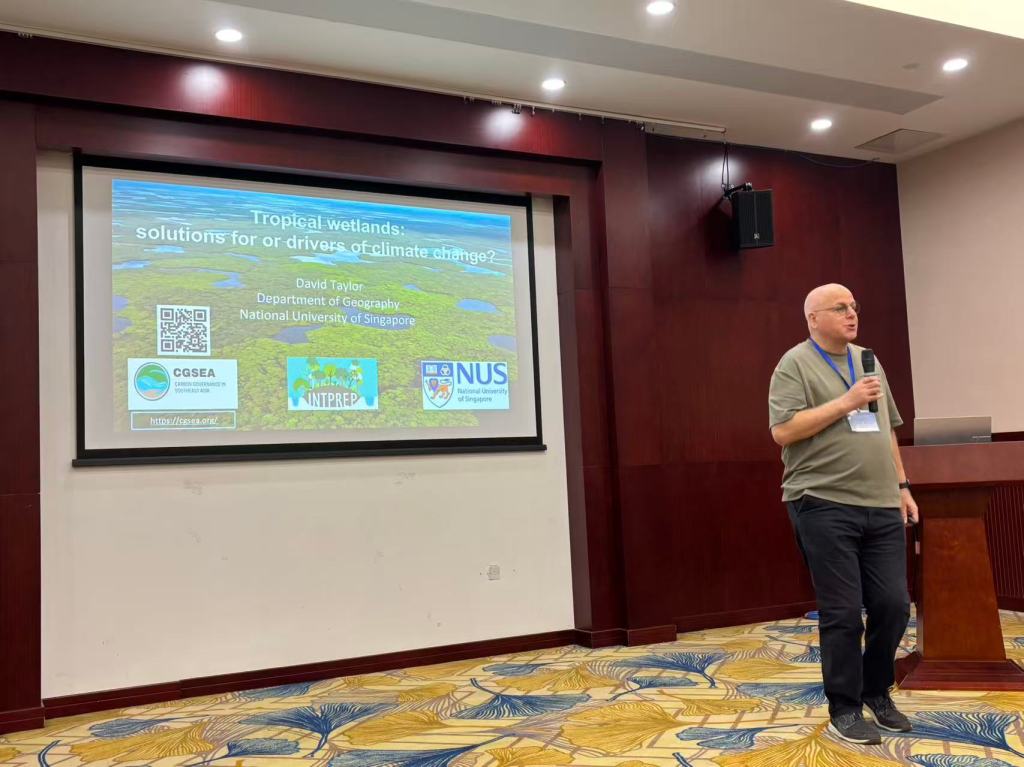
Presentation: Taylor D (2025) Tropical Wetlands: Solutions for or drivers of climate change. Keynote speaker for the 2025 Maritime Silk Road International Conference, Co-organised by Yunnan University and Lanzhou University, Kunming, China, 12 October.
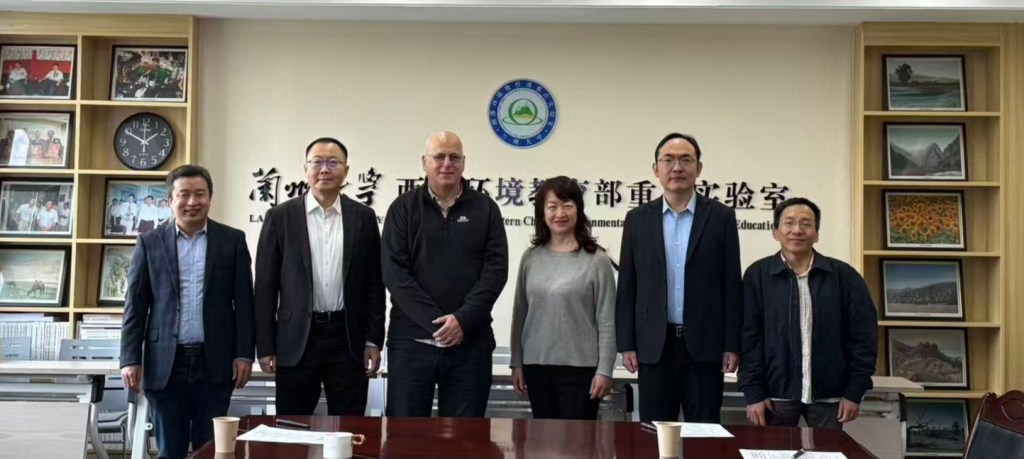
David Taylor recently completed a visit to China, where he was invited to deliver a keynote on ‘Tropical Wetlands: Solutions for or drivers of climate change’ at the 2025 Maritime Silk Road International Conference, co-organised by Yunnan University and Lanzhou University, on 12 October.
The following week, he was invited to present a similar talk at a research seminar for the School of Earth and Environmental Sciences, Lanzhou University, on 20 October.
The success of Taylor’s visit is a testament to the importance, as well as the relevance, of the work being done at CGSEA to better understand carbon sinks, their governance, and their management.
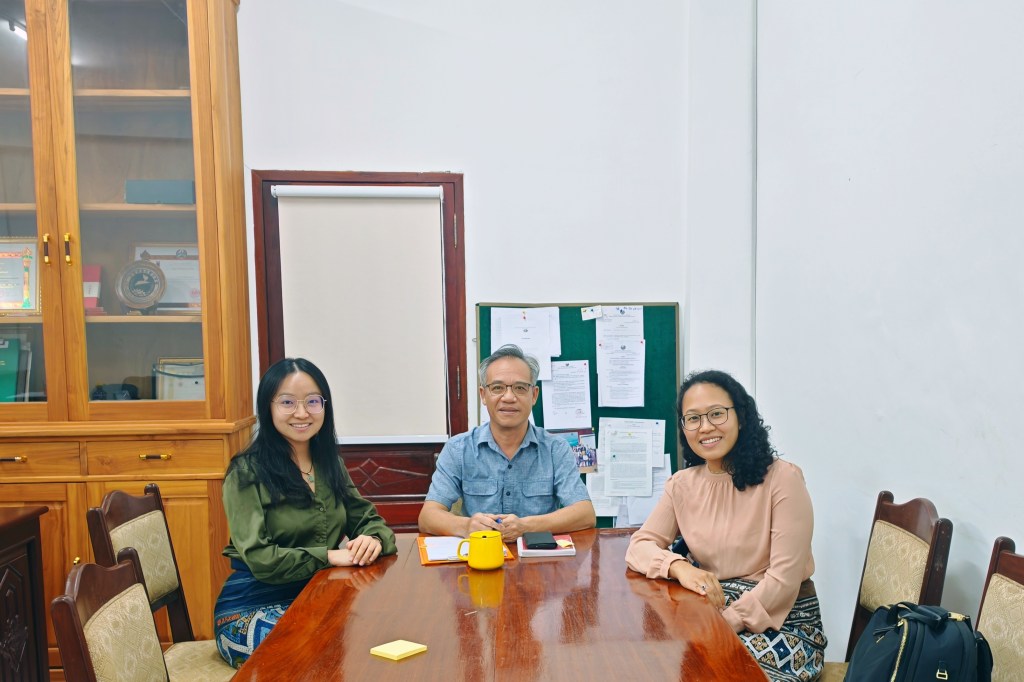
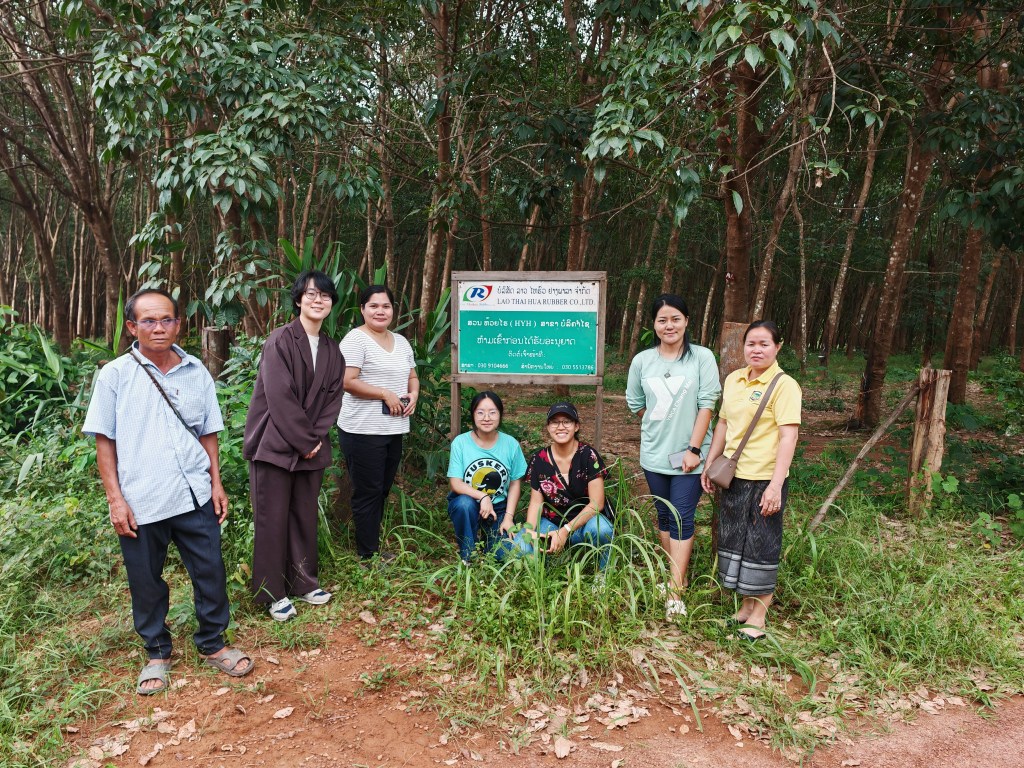
Fieldwork: Yunrui Ren and Shakura Bashir undertook fieldwork at a forestry project site in Bolikhamxai province, Laos, from 23-29 September, 2025.
CGSEA PhD Student Yunrui Ren and PhD affiliate Shakura Bashir conducted surveys and focus group discussions with various respondents at a forestry project site in Laos. They collaborated with two Research Assistants and a faculty member from the National University of Laos, as well as an official from the local District Agriculture and Forestry Office. CGSEA signed an MOU with the National University of Laos in 2023, as part of efforts to establish research networks in the project’s field sites around Southeast Asia, ensuring that our research activities can be facilitated by local partners. This fieldwork was conducted as part of the project’s work package on Terrestrial Forests, and feeds into Ren and Bashir’s respective PhD research.

Announcement: Michelle Miller, Jay Quevedo and Saritha Uda met the Vice Rector for International Collaborations at Universitas Tanjungpura (UNTAN), Prof. Rustamaji, on September 24, 2025.
CGSEA researchers conducting fieldwork in Indonesia met with the Vice Rector for International Collaborations at Universitas Tanjungpura (UNTAN), Prof. Rustamaji, who is also a peatland expert, on September 24, 2025. This meeting consolidated institutional ties between CGSEA and UNTAN, following the MOU signed between the project and the university in 2024, and is representative of the project’s widening institutional collaborations across Southeast Asia.

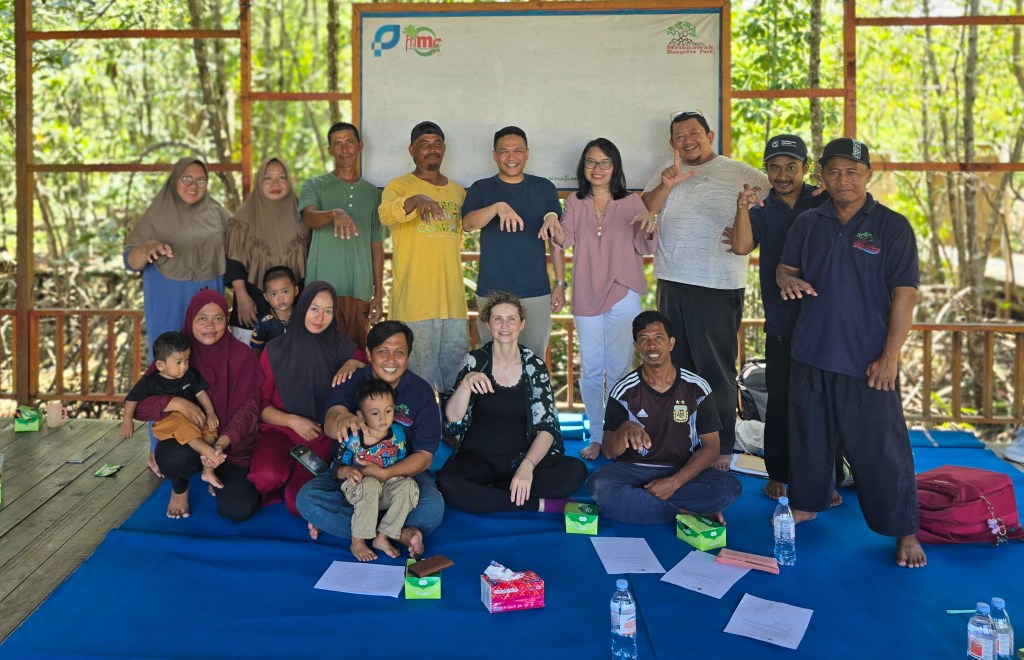
Fieldwork: Michelle Miller, Jay Quevedo and Saritha Uda undertook fieldwork in Mempawah Regency, West Kalimantan, Indonesia from 22-28 September 2025.
The researchers conducted interviews and focus group discussions with a wide range of participants, exploring the management of mangrove and peatland sites in Mempawah Regency, West Kalimantan, Indonesia. This fieldwork was conducted as part of an interdisciplinary effort by the project’s work packages on Coastal and Freshwater Ecosystems, Peatlands and Agricultural Soils, and Systems, Technologies and Social Relations.
Fieldwork was facilitated by, and strengthened institutional cooperation with, Universitas Tanjungpura (UNTAN), and our local collaborator, Dr. Muhammad Pramulya. CGSEA and UNTAN signed an MOU in 2024 in an effort to expand the project’s research networks in Southeast Asia.
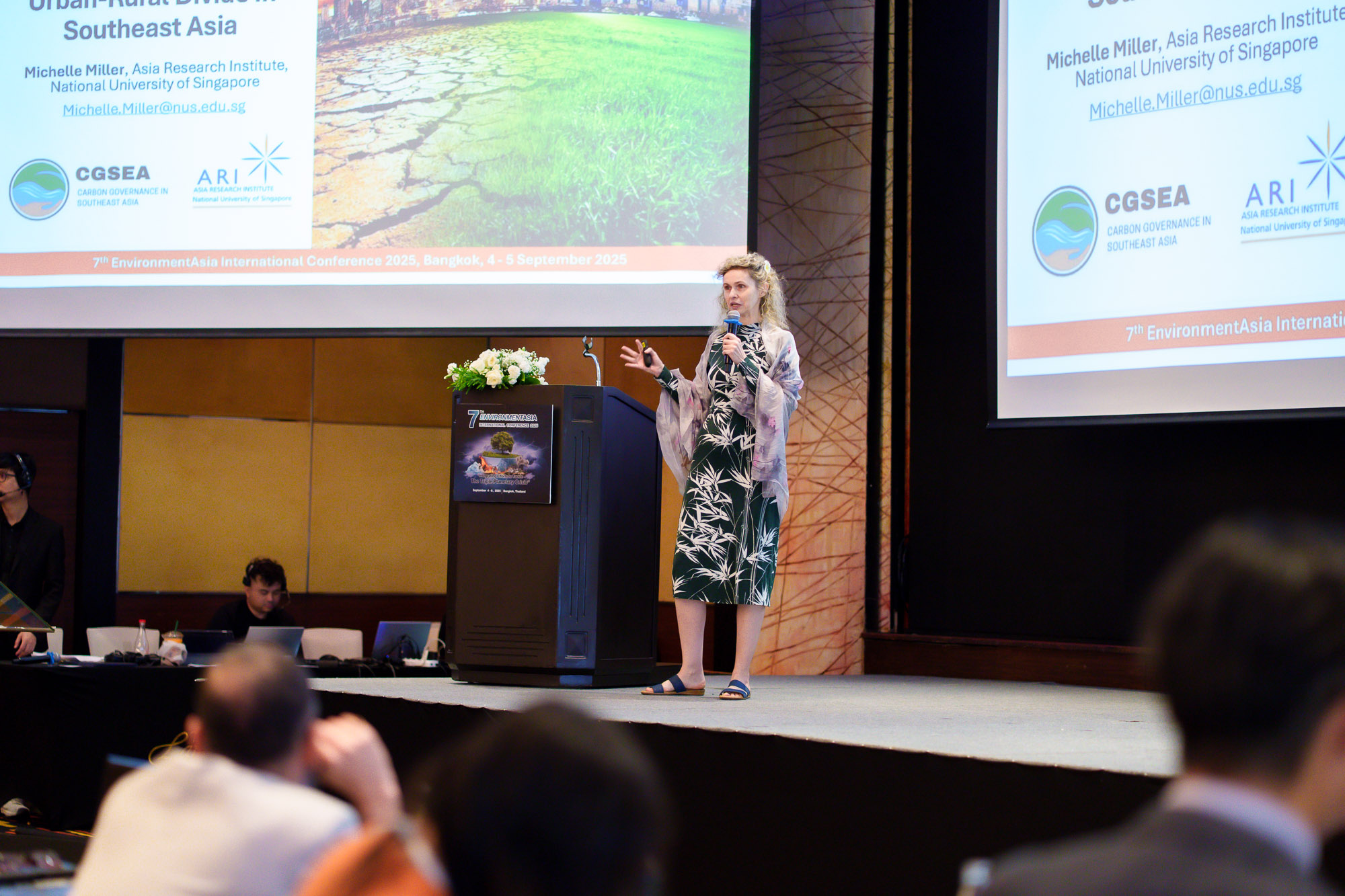
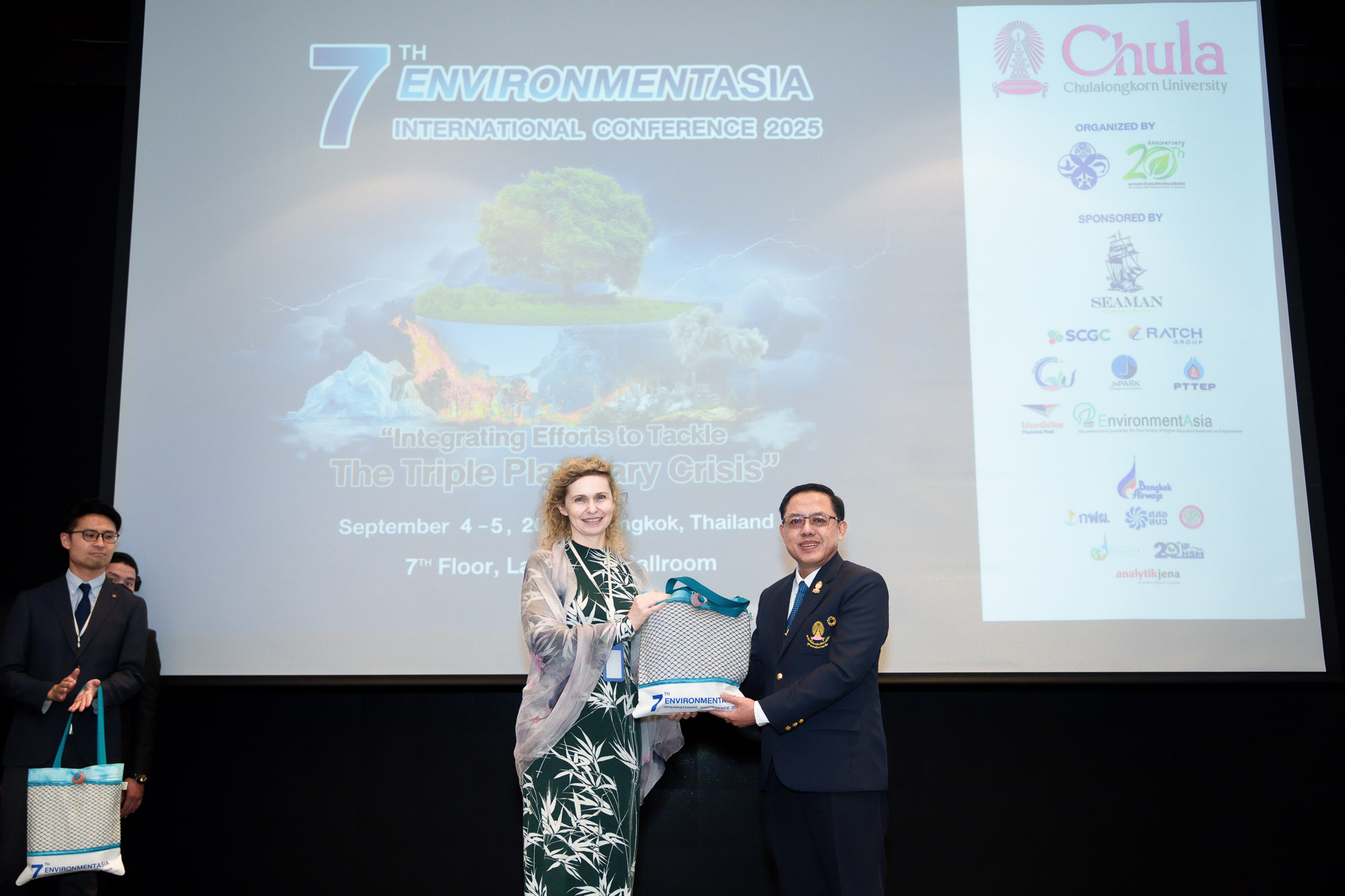
Presentation: Miller MA (2025) A Transboundary Agenda for Nature-Based Solutions: Crossing the Urban-Rural Divide in Southeast Asia. Invited speaker for the 7th EnvironmentAsia International Conference 2025, Co-organised by the Sustainable Environment Research Institute, Chulalongkorn University, and the Thai Society of Higher Education Institutes on the Environment, Bangkok, 5 September.
Michelle Miller was invited to speak on ‘A Transboundary Agenda for Nature-Based Solutions: Crossing the Urban-Rural Divide in Southeast Asia’ at the 7th EnvironmentAsia International Conference 2025.
Miller presented her research on the transboundary governance of nature-based carbon sinks, and shared preliminary findings from a Revealed Preference Experiment conducted in Singapore and Kuala Lumpur by a team of CGSEA researchers from July 2024-February 2025. This research was conducted as part of the project’s work package on the Systems, Technologies & Social Relations found in, and generated by, nature-based carbon sinks, which Miller leads.
Click here to learn more about CGSEA’s work on Systems, Technologies and Social Relations.
Call for Papers: Miller MA & Taylor D [Special Issue] Natural Climate Solutions in Southeast Asia: Positioning Local Carbon Transitions within Global Frameworks. Environmental Policy and Governance.
CGSEA invites submissions for a Special Issue in Enviornmental Policy and Governance examining linkages between Natural Climate Solutions in the tropics and international climate policy and governance frameworks. We invite the submission of abstracts concerned with these themes and issues, grounded in examples from tropical developing countries. In particular, we encourage studies focused on the following themes:
- Multilevel nature-based governance
- Innovations / replications in NCS governance
- Equity, Justice and Community Engagement in NCS Policy and Governance
To propose a contribution to this special issue, please submit an extended 500-800 word abstract outlining the research question(s), theoretical and conceptual contribution, case study, methods, data sources and the relevance of your study to this special issue. In addition, please include a short biographical statement for each (co-)author not exceeding 100 words.
The submission timeline for this special issue is as follows:
- Extended abstract submission: Friday, 28th November 2025 (please send your abstract to michelle.miller@nus.edu.sg)
- Notification of abstract acceptance: Friday, 19th December 2025
- Full paper submission: Friday, 10th April 2026
For more information on this special issue, please click here.
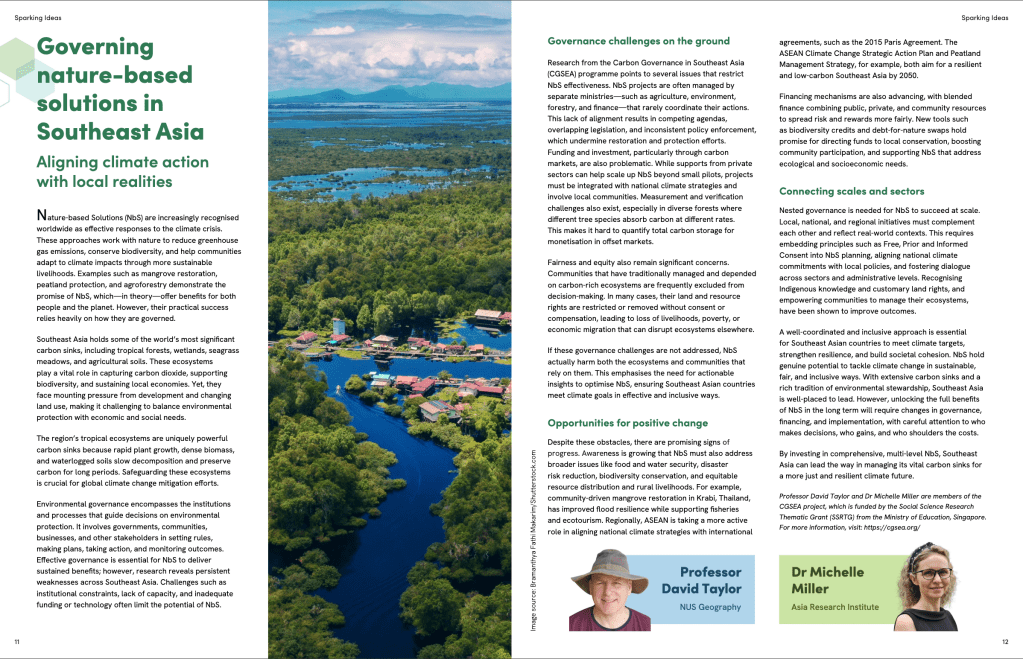
Announcement: CGSEA project featured in Ignite Magazine, issue 2, August 2025.
The CGSEA project was featured in Ignite Magazine, a publication of the Office of the Deputy President (Research & Technology) of the National University of Singapore (NUS). The magazine highlights exciting research being conducted at NUS, and produces themed issues. Issue 2 of the magazine focuses on how ‘researchers at NUS are turning to nature for both inspiration and innovation’, and foregrounds the CGSEA project’s work on governing Nature-based Solutions in Southeast Asia.
The issue spotlights the CGSEA project’s study of how climate action can be and should be aligned with local realities, especially in Southeast Asia. The project’s interrogation of governance challenges on the ground, especially those that restrict the effectiveness of Nature-based Solutions, is foregrounded, as is our focus on addressing fairness and equity in the sites and communities our researchers work with. The issue also mentions opportunities for positive change, but concludes by emphasising the need to connect scales and sectors—to foster nested governance arrangements—that the grant’s research finds is necessary for the effective and socially inclusive management of carbon sinks.
Click here to read the full feature.
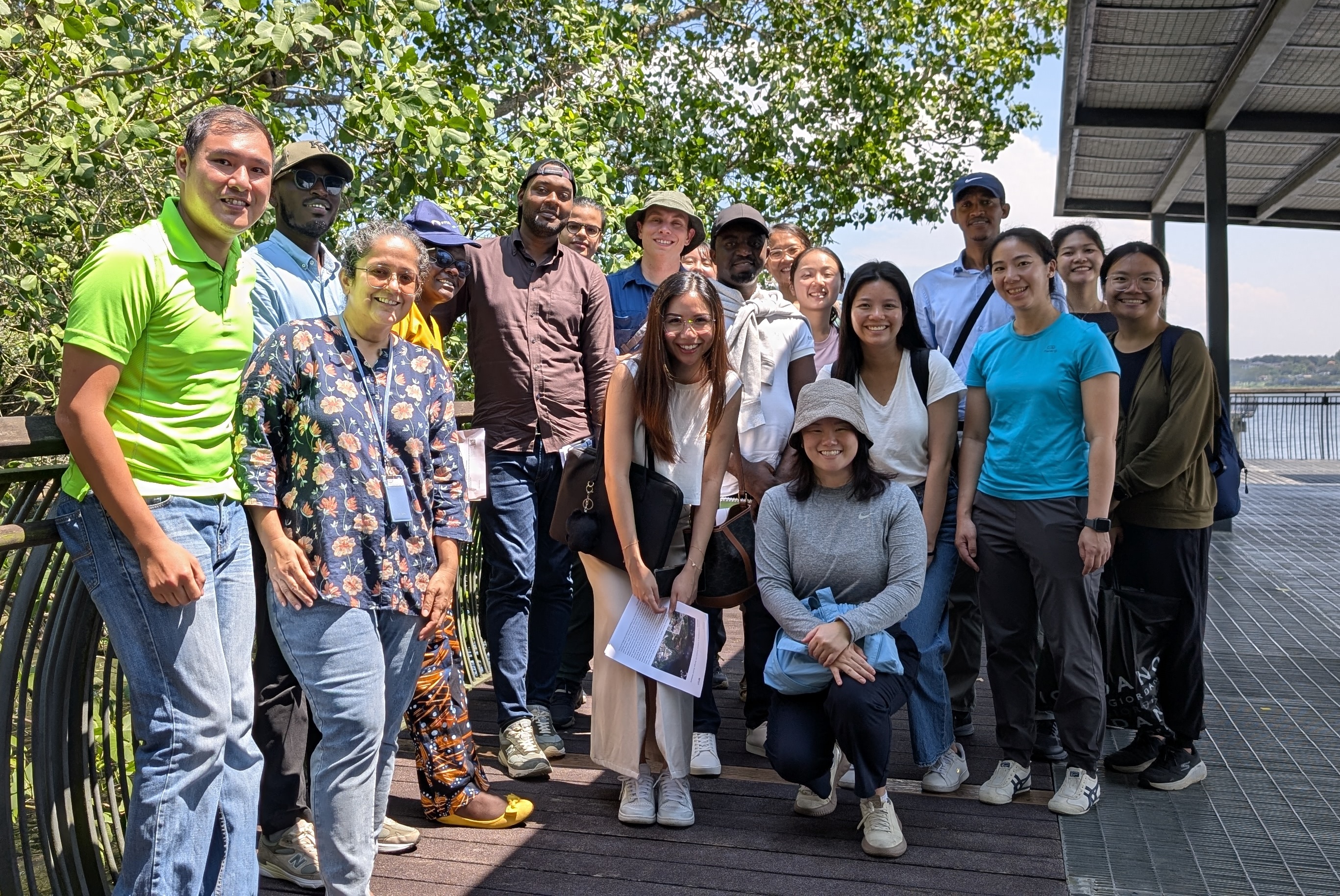
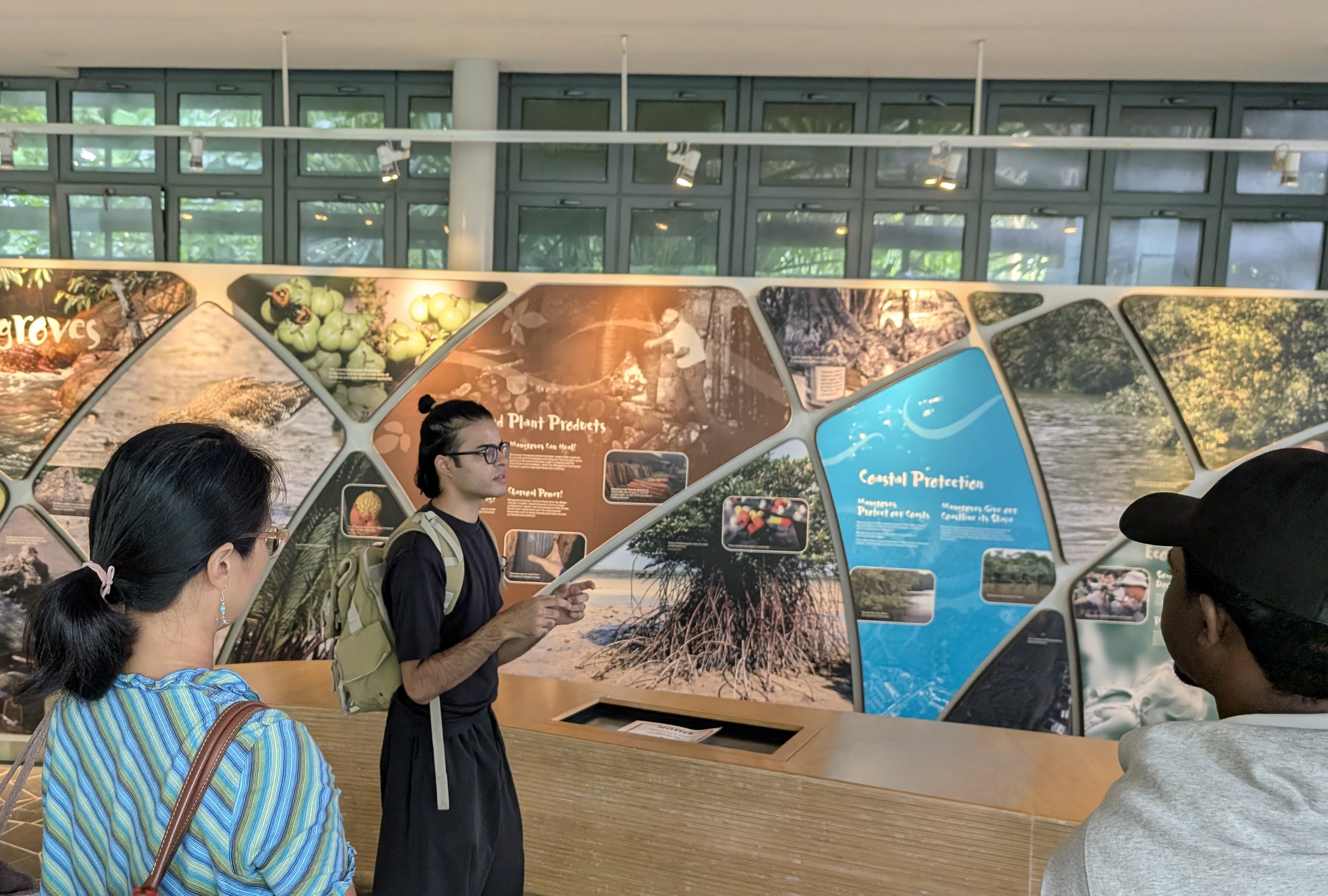

Workshop: Learning Journey: Carbon Project Development and Measuring, Reporting, and Verification (MRV), Sungei Buloh Wetland Reserve (SBWR), Singapore, 26 August 2025.
Yingshan Lau and M. N. Shehryar, in addition to NUS Centre for Nature-based Solutions’ Meriadac Sillanpaa, were invited by the NUS Sustainability Academy to develop and facilitate an outdoor learning journey on Carbon Project Development and Measuring, Reporting and Verification (MRV) at Sungei Buloh Wetland Reserve (SBWR), Singapore, on 26 August 2025.
The outdoor session explored the history of SBWR, the characteristics of mangrove ecosystems and their importance to Singapore and Southeast Asia, a demonstration of MRV techniques used to measure carbon stocks in the field, and an activity for participants to draft a project description document using SBWR as their project site.
To help participants through this activity, the facilitators created an Information Sheet that demystified and clarified the step-by-step processes through which potential project developers conceptualise, develop, and then register their carbon crediting projects. Importantly, the Information Sheet also included frameworks for understanding vital social and ecological integrity concerns that the participants, in their capacity as project approvers, could use to evaluate proposals, and ensure more equitable benefit-sharing of projects’ social and ecological outcomes.
This learning journey was one module in a larger, week-long workshop on Article 6 Implementation Capacity Building for African nations organised by Singapore’s Ministry of Trade and Industry and Singapore Cooperation Enterprise. The session also included observers from Singapore’s Ministry of Sustainability and the Environment and South Pole.
Our role in this learning journey is an example of the collaborative, capacity-building work the CGSEA grant contributes to in Singapore, and in Southeast Asia as a whole, as well as our mission to translate our research into actionable, policy-relevant insights.
Thank you to the Head of NUS Sustainability Academy, CGSEA collaborator Melissa Low, for inviting us to develop and facilitate this session, and, in particular, to Lindy Queck and Danielle Lim for their considered feedback and excellent coordination!
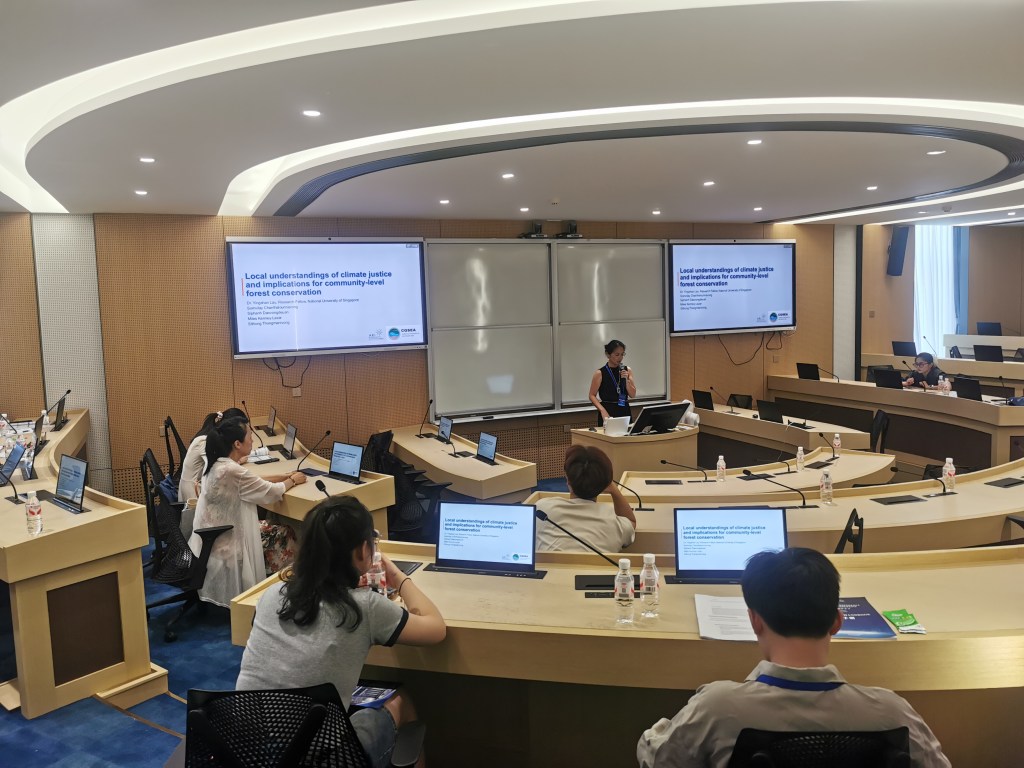
Presentation: Lau Y (2025) Local Understandings of Climate Justice and Implications for Community-level Forest Conservation. International Conference on Climate Leadership, Co-organised by the Harbin Institute of Technology and University College London, Harbin, China, 22 July.
Yingshan Lau presented a paper on ‘Local Understandings of Climate Justice and Implications for Community-level Forest Conservation’ at the International Conference on Climate Leadership. Lau’s research is conducted as part of the project’s work package on Terrestrial Forests.
Click here to learn more about CGSEA’s work on Terrestrial Forests.
Announcement: Happy World Mangrove Day from CGSEA! 🌿 (26th July)
CGSEA proudly joins the global community in celebrating World Mangrove Day!
Our researchers from the project’s work package on coastal and freshwater ecosystems study mangrove governance across Southeast Asia. One of our study sites, Del Carmen, the Philippines, has demonstrated a powerful shift from exploitative practices to transformative conservation.
This journey has led to its recognition as a Ramsar Wetland of International Importance, showcasing the vital role of local action in global environmental protection.
Click here to learn more about CGSEA’s work on Coastal and Freshwater Ecosystems.
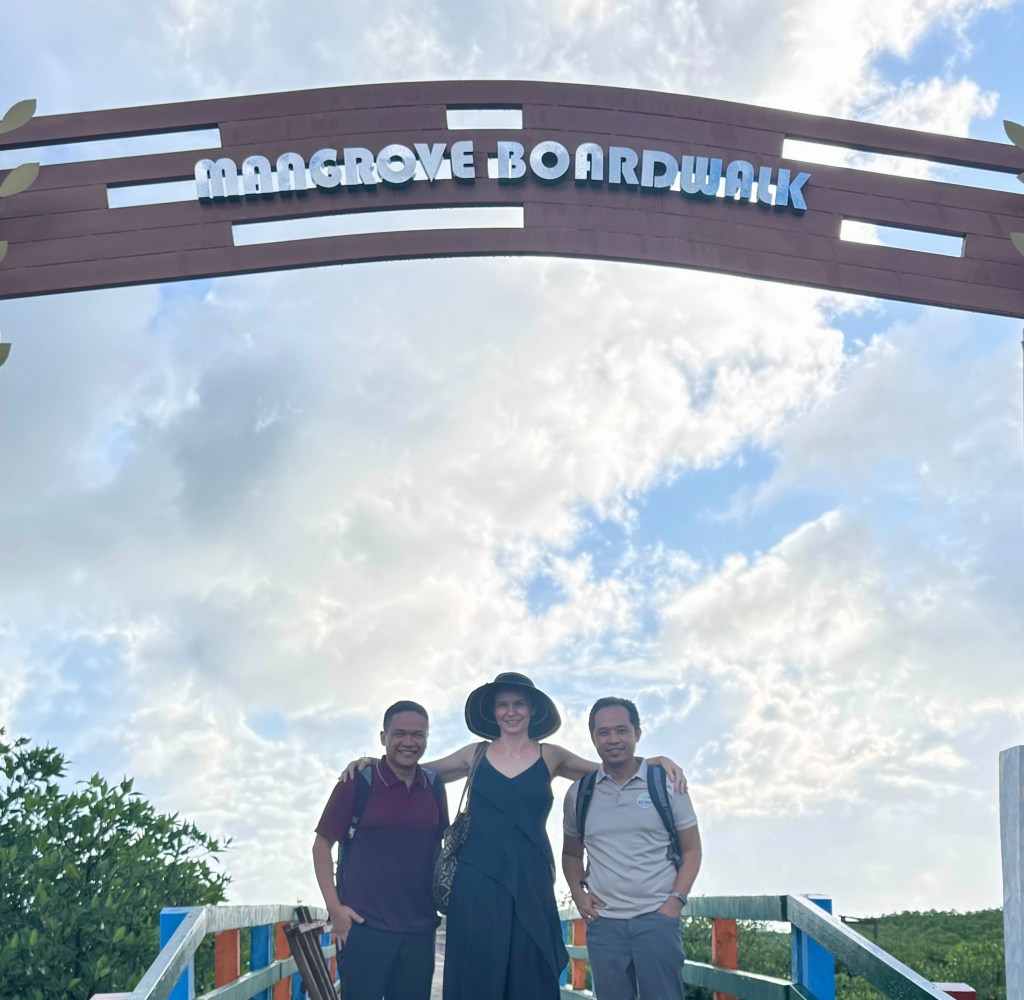

Presentation: Quevedo JMD (2025) Philippines on the Map: Advancing Blue Carbon Research Frontiers. Resource speaker for Mangrove Blue Carbon Roadmap to 2030 and beyond, Organised by the Forestry Development Centre, University of the Philippines Los Baños, Manila, Philippines, 18 June.
Jay Quevedo served as a Resource Speaker for Mangrove Blue Carbon Roadmap to 2030 and beyond, a science-policy forum organised by Dixon Gevaña, who is the Director of the University of the Philippines Los Baños’ Forestry Development Centre.
The forum brought together experts from government, academia and civil service to discuss ‘future-proofing livelihoods and technologies to conserve mangroves’. In a talk titled ‘Philippines on the Map: Advancing Mangrove Blue Carbon Frontiers’, Quevedo shared his research on Blue Carbon livelihoods, conducted in the Philippines for CGSEA’s work package on Coastal and Freshwater Ecosystems.
Click here to learn more about CGSEA’s work on Coastal and Freshwater Ecosystems.

Panel: Lau Y & Inthakoun L (2025) Co-organised one themed panel on The governance of the forest carbon frontier in Southeast Asia. Association for Asian Studies (AAS) in Asia Conference, Kathmandu, Nepal, 2 June.
Yingshan Lau and Lamphay Inthakoun co-convened a themed panel titled The governance of the forest carbon frontier in Southeast Asia at the Association for Asian Studies-in-Asia (AAS-in-Asia) conference in Kathmandu, Nepal, on June 2.
Their panel featured interdisciplinary work conducted as part of the project’s work package on Terrestrial Forests. The researchers presented on a wide range of topics, including:
- the types of knowledge and values are prioritised in ranking the quality of carbon credits, and how diverse values are translated into indicators (such as ‘high-integrity’ carbon credits);
- why swidden cultivation in Laos is discouraged by the state, and how the state’s perspectives are reinforced by international development programs that fund forestry and climate change work in Laos;
- key issues and challenges in promoting forest carbon project development in the Philippines, and some possible solutions;
- the forest carbon commodity chain in Laos, and its key actors.
The paper presenters included Yingshan Lau (for 1), Lamphay Inthakoun (for 2), Dixon Gevaña (for 3), and Yunrui Ren (for 4). The panel was chaired by Gevaña.
Panel abstract: “Agriculture, forestry, and land use is the third-largest source of global anthropogenic greenhouse gas (GHG) emissions responsible for climate change. In response, a major focus of international policy concerns GHG emissions related to tropical forests as a carbon sink, including projects of Reducing Emissions from Deforestation and Forest Degradation (REDD+), afforestation, reforestation, and revegetation (ARR), and improved forest management (IFM). Southeast Asia is a key locus of such programs considering its high percentage of forest cover combined with high rates of deforestation related to the region’s rapid economic growth. Extensive research has been conducted on REDD+ projects across the region, critically demonstrating how they have had limited effects on deforestation rates, excluded local and Indigenous peoples from forest areas, and have been poorly governed. However, the landscape of forest carbon projects has significantly evolved in recent years, including approaches of REDD+ that operate at larger geographical scales, a more substantial role for the private sector actors, a growing emphasis on high-quality carbon credits, and more diverse forms of forest carbon interventions (e.g. ARR and IFM). The aim of this panel is to take stock of and analyse this moving frontier of forest carbon governance across the region as a means of offering ways for navigating this uncertain and dynamic field. Altogether, panellists demonstrate how the modern, commodified concept of forest carbon is being mobilised from environmental policy-making centres to the rural forest margins of Southeast Asia.”
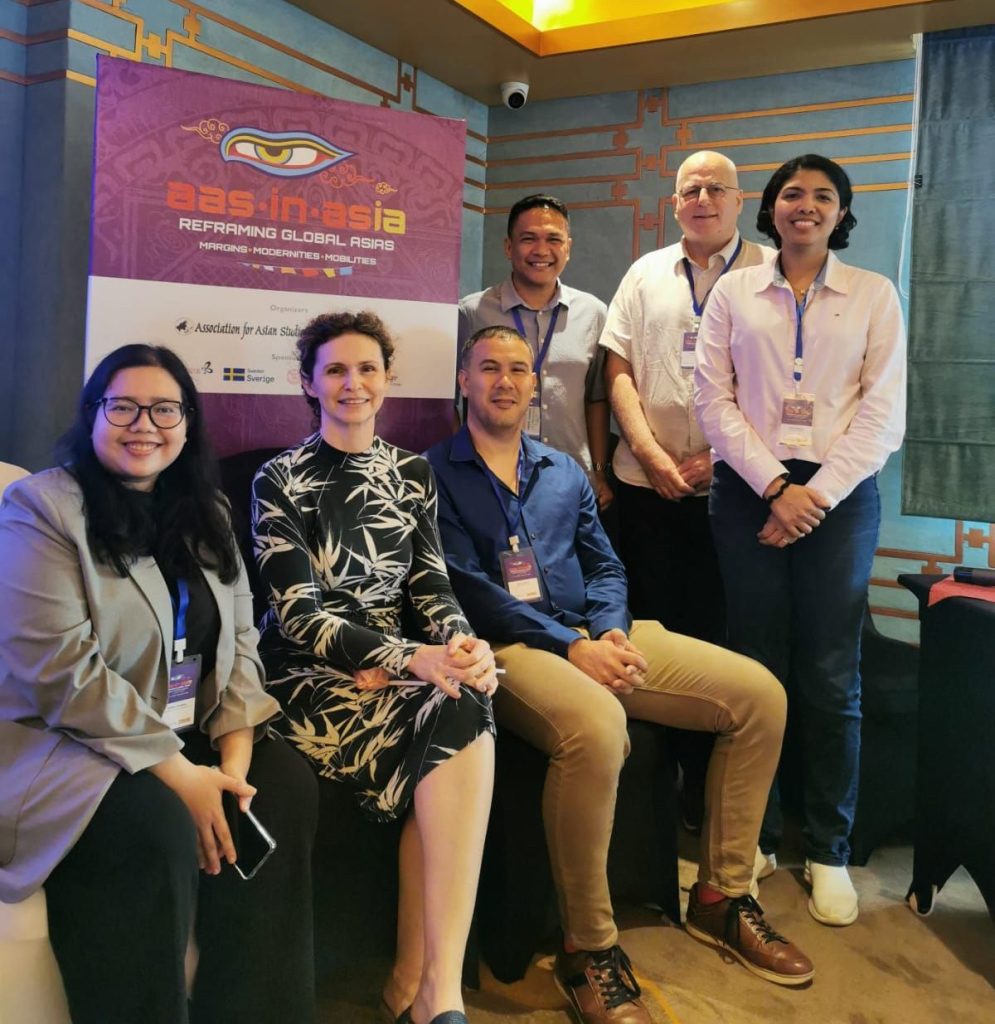
Panel: Miller MA & Taylor D (2025) Co-organised one themed panel on Climate Governance and Carbon Modernities in Southeast Asia’s Margins. Association for Asian Studies (AAS) in Asia Conference, Kathmandu, Nepal, 2 June.
Michelle Miller and David Taylor co-convened a themed panel titled Climate Governance and Carbon Modernities in Southeast Asia’s Margins at the Association for Asian Studies-in-Asia (AAS-in-Asia) conference in Kathmandu, Nepal, on June 2.
Their panel featured interdisciplinary work conducted as part of the project’s work package on Systems, Technologies and Social Relations. The researchers presented on a wide range of topics, including:
- whether and to what extent urban residents in Singapore and Kuala Lumpur are Willing-to-Pay for ecosystem services provided by carbon sinks in rural areas across Southeast Asia;
- how global conversations and developments regarding Nature-based Solutions become nested into national priorities, programs and outcomes in Southeast Asia;
- how Voluntary Carbon Market (VCM) projects marginalise women– who are often not recognised as land rights holders–and, in doing so, establish ‘gendered carbon frontier[s]’ at project site areas, where gender-based violence is employed as a tool of market expansion, and for the extraction of carbon credits from indigenous and local communities;
- the prevalence of (and possible ways to address) ‘carbon colonialism’ and green-or ‘grain’-washing in food-production systems, practiced by agri-conglomerates that control integrated supply chains across sectors;
- how protected areas and associated blue carbon governance policies impact the lives of marginalised communities in coastal regions.
The paper presenters included Michelle Miller (for 1), Helena Varkkey (for 2), Yustina Octifanny (for 3), Danny Marks (for 4), and Jay Quevedo (for 5). The panel was chaired by David Taylor.
Panel abstract: “This panel examines how global carbon dynamics are transforming climate governance in Southeast Asia’s gendered, rural and discursive margins. Theoretically and conceptually, the panel is concerned with the role of carbon (geo)politics in shaping spaces of inclusion and exclusion in climate governance regimes. Southeast Asia’s internationally important carbon sinks are at heightened risk of degradation and predation owing to competing demands on their finite resources. Our presenters thus treat carbon valuations of mangrove forests, peatlands and agricultural soils as an issue of power, grounded in specific tenurial and societal arrangements, and rendered mobile through complex rural-urban linkages. The panel begins by locating these regional challenges to developing nature-based solutions within international climate discourses and frameworks. Presenters then zoom in on case studies that show how carbon modernities create, or compound existing, experiences of marginality. Gendered carbon inequalities in Indonesia’s peatlands, carbon colonialism in Thailand’s maize monocropping areas, and intersections between marginality and mangrove conservation tied to blue carbon policies in the Philippines are explored. Marginal climate discourses about overcoming the rural-urban divide are also analysed in a revealed preference experiment that tests the extent to which urban residents in Kuala Lumpur, Malaysia, and Singapore value carbon sink resources on which they depend in remote and rural areas. Taken together, the presentations in this panel seek to highlight hidden voices and viewpoints in Southeast Asia’s carbon transition that may prove significant in addressing ongoing challenges to the climate crisis.”
Announcement: Happy World Peatlands Day from CGSEA! 🌱 (2nd June)
Peatlands play crucial roles in sequestering carbon, regulating the climate, and providing vital habitats for biodiversity.
CGSEA researchers from the project’s work package on Peatlands and Agricultural Soils study the sociocultural, economic, and ecological contexts peatland areas across Southeast Asia are situated in, producing policy-relevant insights in the process.
The project’s interdisciplinary research also contributes to the International Peatland Society‘s’ call for the responsible, science-and experience-based management of peatland areas, especially in the project’s field sites across Southeast Asia.
Click here to learn more about CGSEA’s work on Peatlands and Agricultural Soils.

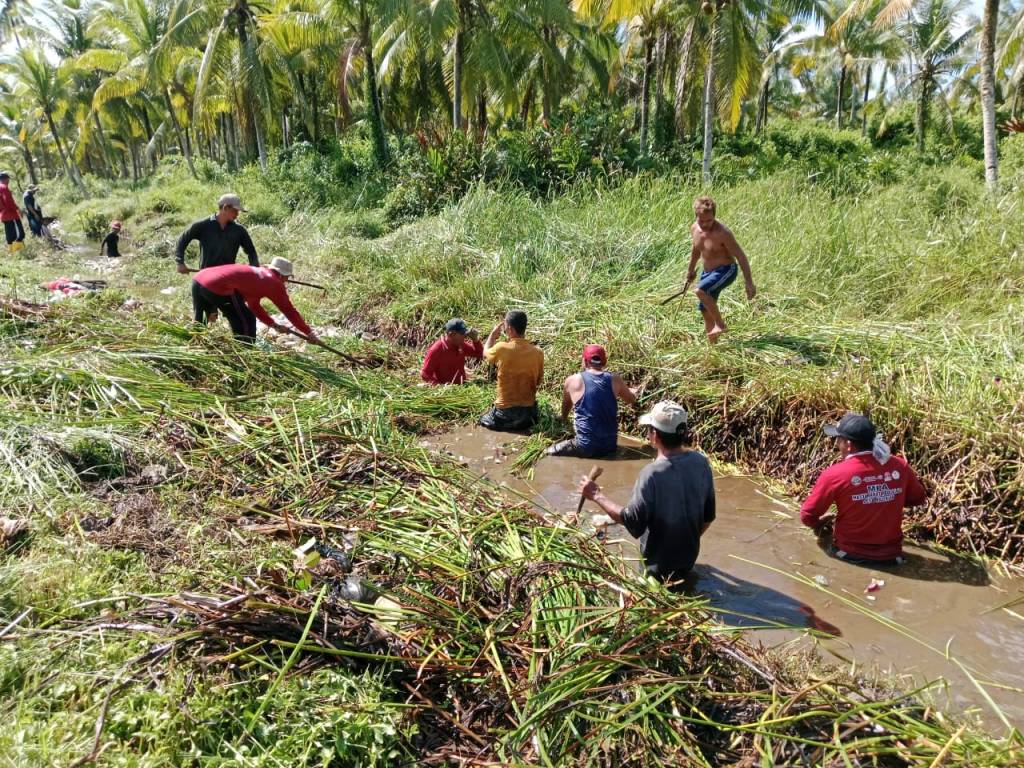

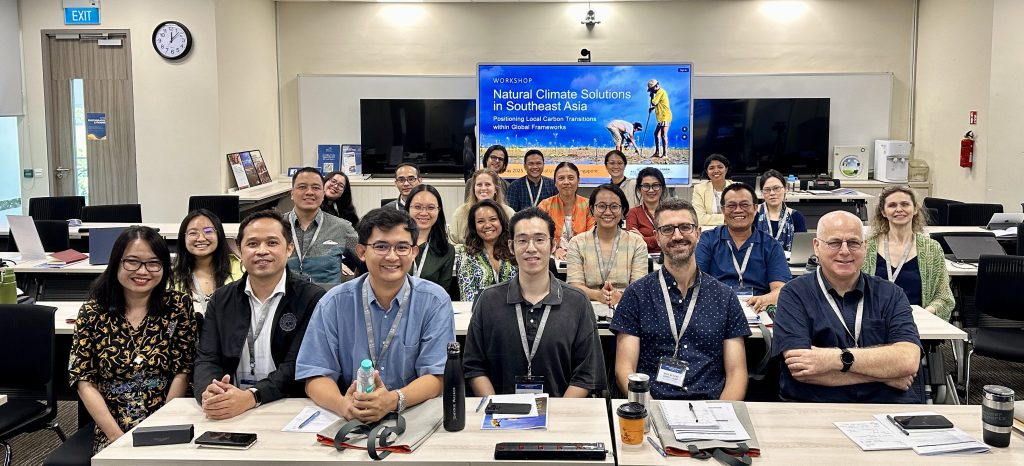
Workshop: Workshop on Natural Climate Solutions in Southeast Asia, ARI, NUS, 8-9 May 2025 (convened in a hybrid format).
The CGSEA team organised a two-day workshop at the Asia Research Institute, National University of Singapore, on 8-9 May 2025, inviting researchers and practitioners from eleven countries to share new work on Natural Climate Solutions (NCS). Participants discussed local-global climate policy links, carbon sink governance, connecting communities to markets, NCS tech, health and wellbeing, and new carbon frontiers in Southeast Asia.
Key discussions and insights included:
- 🌏 Global climate frameworks often prioritise carbon and conservation, while ethnographic research shows local communities in Southeast Asia need solutions supporting livelihoods, food security and equity. Bridging these priorities emerged as essential for real impact.
- ⚖️ NCS projects risk reinforcing inequalities if land tenure rights, benefit-sharing, and true participation (especially for Indigenous and Local Communities) aren’t centred. Adaptive multi-level governance, strong local leadership, and cross-sector partnerships are essential.
- 🔎 Transparent and robust carbon accounting and monitoring build credibility. Integrating climate action with education, health, and livelihoods—including social enterprise models—delivers lasting community benefits.
The CGSEA team thanks all participants of the workshop for advancing the conversation on just and equitable Natural Climate Solutions in Southeast Asia, and also thanks the ARI events team for making the workshop possible! 🌳🤲
Announcement: Happy World Forest Day from CGSEA! 🌲 (21 March)
World Forest Day highlights the importance of forests for climate regulation and biodiversity, and their role as nature-based carbon sinks.
CGSEA researchers study forests, and the sociocultural, economic, and ecological contexts they are situated in, as part of the project’s work package on Terrestrial Forests.
To date, research for this work package had led to three field visits to various sites in Laos, a paper on estimating above-ground tropical forest biomass in Laos, and another paper on participatory measurement, reporting and verification (MRV) of forest carbon by indigenous and local communities in Vietnam.
Click here to learn more about CGSEA’s work on Terrestrial Forests.
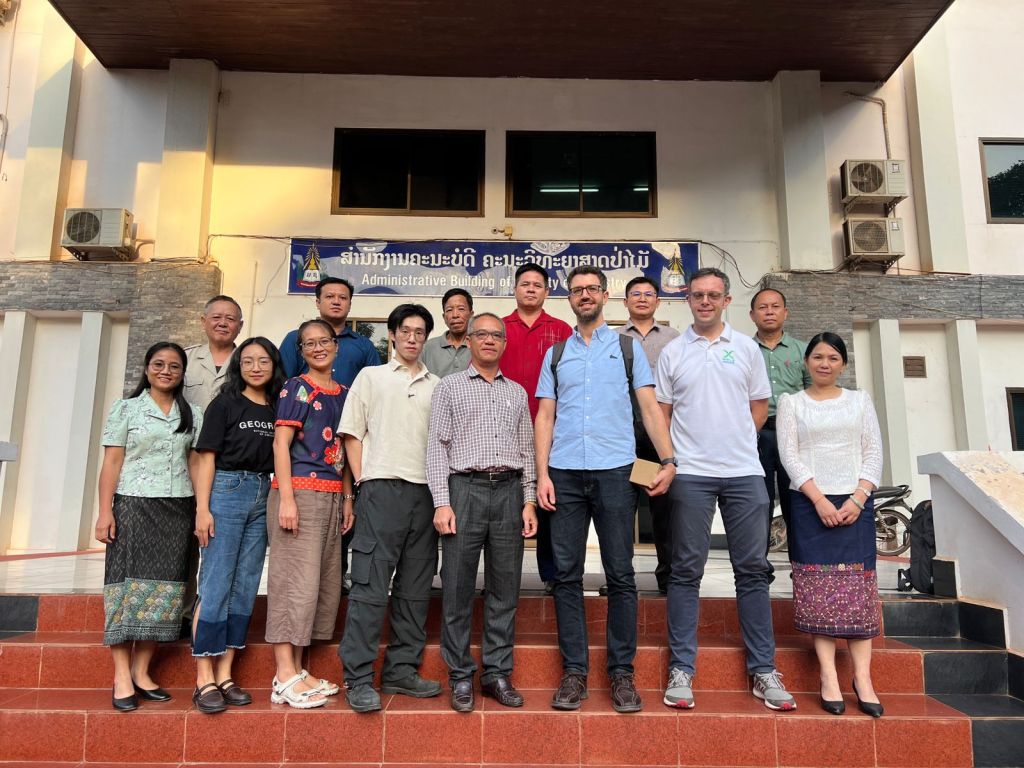

Fieldwork: Michelle Miller, Miles Kenney-Lazar and Sithong Thongmanivong undertook fieldwork in Luang Prabang Province, Laos, from 2-8 March 2025.
The researchers conducted interviews and focus group discussions, engaging a wide range of respondents involved in REDD+ projects, focusing on gendered carbon dynamics, developments in the jurisdictional REDD+ approach, and private sector interventions in forest carbon governance. This fieldwork was conducted as part of the project’s work packages on Terrestrial Forests, and on Systems, Technologies and Social Relations.

Announcement: Michelle Miller, M. N. Shehryar and Jay Quevedo hosted a delegation from Thailand at ARI, NUS, on February 7th, 2025.
The delegation visited ARI to learn about research being done on waste management and circular economy practices, and was led by Dr Sujitra Vassanadumrongdee, Senior Researcher at the Environmental Research Institute, Chulalongkorn University, and Mr Pornphrom N.S. Vikisreth, Chief Sustainability Officer of Bangkok.
Michelle Miller and M. N. Shehryar shared insights from their research on community composting in Singapore in a circular economy frame, including policy-relevant takeaways that could be adapted to the Bangkok context. Jay Quevedo presented his work on blue economies in the Philippines, highlighting the potential impact of conservation frameworks in tandem with carbon credit initiatives on local livelihoods and the efficacy of conservation programs targeting mangrove and seagrass ecosystems.
This visit is a testament to CGSEA’s role in fostering cross-collaboration on environmental governance issues in Southeast Asia, and is an example of the outreach the project conducts with researchers in the region to share knowledge and explore collaborative possibilities.
Announcement: Happy World Wetlands Day from CGSEA! 💧🌿 (2nd February)
World Wetlands Day raises awareness of the importance of wetlands as ecosystems providing a range of climate and biodiversity related ecosystem services, as well as their role sequestering carbon from the atmosphere.
The project’s work package on Coastal and Freshwater Ecosystems studies wetlands, and the Systems, Technologies and Social Relations they are situated in, across Southeast Asia. To date, research for this work package has led to two field visits to Del Carmen in the Philippines, and has produced four journal articles and a book chapter.
Click here to learn more about CGSEA’s work on Coastal and Freshwater Ecosystems.
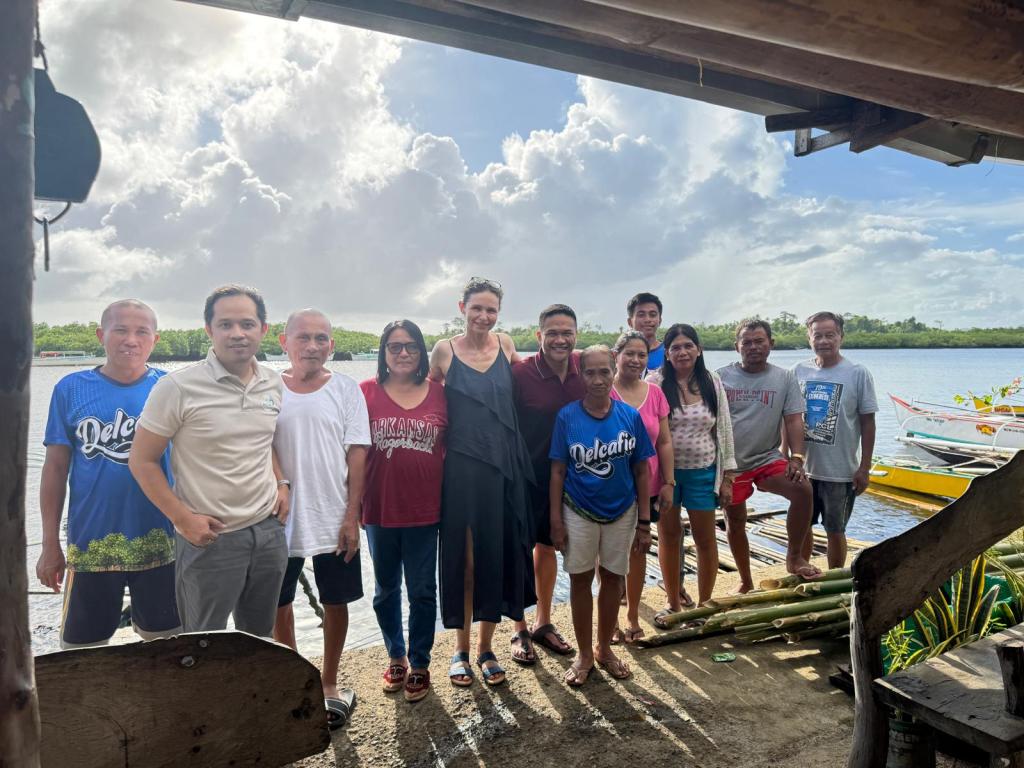
2024
Announcement: CGSEA congratulates Yustina Octifanny for receiving a grant from the UC Berkeley Southeast Asia Lives and Histories Small Grants Program at UC Berkeley Center for Southeast Asia Studies!
This award will supplement Octifanny’s research in Central Kalimantan, Indonesia, tentatively titled ‘Carbon Frontiers: Territorialization of carbon markets and socio-environmental transformations in Southeast Asia peatlands‘.
Octifanny is a PhD student at the National University of Singapore’s Department of Geography, and is supervised by David Taylor, Michelle Miller, and Helena Varkkey.
Click here to learn more about Octifanny and her fellow awardees.

Fieldwork: Yingshan Lau undertook fieldwork in Laos from 18-28 November 2024.
Lau conducted interviews and focus group discussions in Laos, studying REDD+ projects and climate justice dimensions in forest carbon programs. She also attended a regional exchange on the social integrity of forest carbon, hosted by the Food and Agriculture Organisation of the United Nations (FAO) and the Mekong Region Land Governance (MRLG) project, as an observer. This fieldwork was conducted as part of the project’s work package on Terrestrial Forests, and is a testament to CGSEA’s commitment to develop, deepen, and expand research networks in Southeast Asia, including, in this instance, with the MRLG project.

Fieldwork: Michelle Miller, Jay Quevedo and Dixon Gevaña undertook fieldwork in Del Carmen, the Philippines, from 17-24 November 2024.
The researchers conducted interviews and focus group discussions to understand respondents’ participation in, and perceptions of, blue carbon governance in mangrove forests, as well as the gendered dimensions of their participation and perceptions. This fieldwork was conducted as part of the project’s work packages on Coastal and Freshwater Ecosystems, and on Systems, Technologies and Social Relations.
Media mention: (2024) As El Nino fuels fire risk, South-east Asia prepares for haze crisis. The Straits Times, 21 November.
Helena Varkkey was interviewed by The Straits Times for an article on fire risk and the transboundary haze crisis in Southeast Asia.
Varkkey asserted that ‘[f]ires, once they occur, will likely be sustained over long periods and move across national boundaries.’ Drawing on her experience consulting for the Association for Southeast Asian Nations (ASEAN) on policy interventions that can curb worsening air pollution in the region, she argued that ‘a new regional roadmap to address the issue will prove vital ahead of the upcoming season’, adding that ‘[i]t’s important to focus on data standardisation, sharing and use (of) air quality indexes, hotspot data to support cross-border coordination’.
Click here to read the full article.
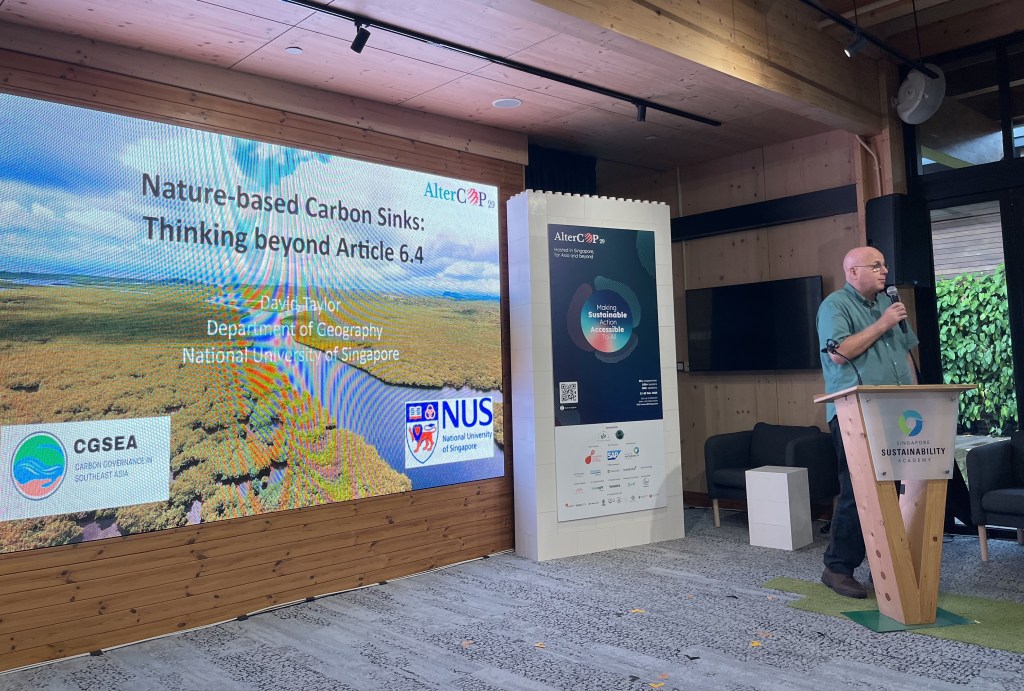
Presentation: Taylor D (2024) Nature-based Carbon Sinks – Thinking beyond Article 6.4. AlterCOP 29, Singapore, 19 November.
David Taylor was invited to give an Expert Talk on ‘Nature-based Carbon Sinks – Thinking beyond Article 6.4’ at AlterCOP 29. Taylor focused on Nature-based Carbon Sinks and their carbon sequestration potential as it pertains to Article 6 of the Paris Agreement (that governs the creation and trade of carbon credits, including those generated by nature-based carbon sinks).

Presentation: Yuchuan Z (2024) Local calibration of GEDI L4A data with Lao National Forestry Inventory for improved Above-Ground Biomass Estimation. ForestSAT 2024, Organised by SCION, Rotorua, New Zealand, 11 September.
Zhou Yuchuan presented a chapter from his PhD on ‘Local calibration of GEDI L4A data with Lao National Forestry Inventory for improved Above-Ground Biomass Estimation’ at ForestSAT 2024. Yuchuan is a PhD Student at the National University of Singapore’s Department of Geography, and is supervised by David Taylor. His doctoral dissertation aims to contribute ‘Towards Reliable, Transparent, and Spatiotemporally Explicit Forest Carbon Accounting in Southeast Asia.’
Click here to read the journal article presented by Yuchuan at ForestSAT 2024.

Announcement: CGSEA congratulates Dixon Gevaña for winning the APAFRI (Asia Pacific Association of Forestry Research Institutions) Forestry Award 2024!
The award is ‘presented to the chosen scientist(s) to honour his/her exceptional scientific accomplishments and significant contributions to the fields of forestry and forest products research.’ Gevaña is part of CGSEA’s work package on Coastal and Freshwater Ecosystems, and works on blue and teal carbon ecosystems in the Philippines.
Click here to learn more about Gevaña and the CGSEA team.
Click here to access image source.

Fieldwork: Danny Marks undertook fieldwork in Thailand from July to mid-August 2024.
Marks conducted qualitative research in Thailand, studying participation in, and perceptions of, blue carbon governance in mangrove forests. In the photo above, Marks (second from the right), is pictured (from left to right) with the Director of the Save Andaman Foundation, a staff member from the foundation, and his Research Assistant, Kittima Leeruttanawisut. This fieldwork was undertaken as part of the project’s work package on Coastal and Freshwater Ecosystems.

Short article: Varkkey H, Miller M & Ashfold M (2024) Peatlands and the Climate: This year’s COP29 must build on COP28. Fulcrum, 7 August.
Helena Varkkey and Michelle Miller, alongside Matthew Ashfold, co-authored a short article for Fulcrum, a publication of ISEAS, on ‘Peatlands and the Climate: This year’s COP29 must build on COP28.’
The authors note how ‘carbon-rich peat ecosystems hold great potential to mitigate climate change, and help meet Southeast Asian national climate targets’, arguing that ‘the increased priority and action on peatlands must be continued from COP28 into this November’s COP29.’
Click here to read the full short article.

Fieldwork: Yustina Octifanny undertook preliminary fieldwork in CentralKalimantan, Indonesia, from 11 June-30 July 2024.
Octifanny conducted site observations for future fieldwork that will inform her doctoral dissertation, studying gendered dimensions and customary land rights in peatland areas. She visited several sites in Central and West Kalimantan, two provinces in the Indonesian part of Borneo, including Palangkaraya and Pontianak, where she established relationships with NGOs, government agencies, academic experts, village and customary leaders, and local farmers. This fieldwork was conducted as part of the project’s work package on Peatlands and Agricultural Soils.
Octifanny is a PhD Student at the National University of Singapore’s Department of Geography, and is supervised by David Taylor. Her doctoral dissertation studies ‘Carbon Frontiers: Territorialization of carbon markets and socio-environmental transformations in Southeast Asia peatlands’, focusing on Kalimantan, Indonesia.
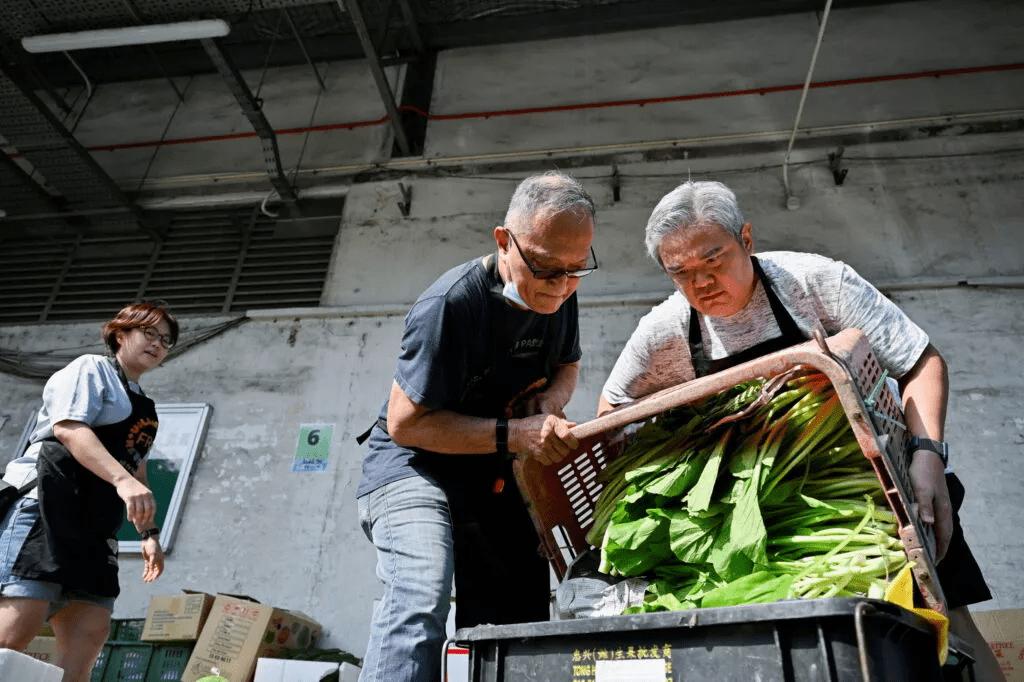
Short article: Miller M, Pui C & Rice W (2024) Urban composting creates climate action opportunities for Singapore. East Asia Forum, 10 July.
Michelle Miller and Wayne Rice, alongside Cuifen Pui, co-authored a short article for East Asia Forum on how ‘Urban composting creates climate action opportunities for Singapore.’
The authors that ‘urban composting creates climate action opportunities for Singapore’ in line with Singapore’s National Zero Waste Masterplan, concluding that ‘compost collaborations should be nurtured, rewarded and replicated, as…. [t]hese collaborations may provide a firm basis for national climate action by strengthening Singapore’s zero-waste goals and enhancing food security.’
Click here to read the full short article.
Presentation: Tonoto P (2024) Opportunities and Challenges of Sustainable Forestry-Based Technology, Organised by the Indonesian Cluster Association, online, 14 June.
Prayoto Tonoto was invited to present a talk in Bahasa Indonesia on ‘Opportunities and Challenges of Sustainable Forestry-Based Technology’ at an online webinar. The webinar was organised by the Indonesian Cluster Association, and ‘explore[d] the opportunities and challenges in sustainable forestry development that integrates advanced technology and active community participation’ (Translation of webinar blurb provided by Google Translate).
Click here to watch the full webinar.

Announcement: Melissa Low co-chaired the daily morning meetings of RINGO at the 60th Bonn Climate Change conference, held between 3-13 June, 2024.
RINGO, or Research and Independent Non-Governmental Organisations, is one of the nine NGO constituencies recognised by the United Nations Framework Convention on Climate Change (UNFCCC). Low has been a member of the 12-member RINGO Steering Committee since 2018.
Low is a Research Fellow at the National University of Singapore’s NUS Centre for Nature-based Climate Solutions, and is concurrently pursuing a part-time PhD at the Department of Geography, supervised by David Taylor. She has participated in the UNFCCC’s Conference of Parties (COP) for over a decade and is an active sustainability thought leader.
Click here to learn more about the CGSEA team.
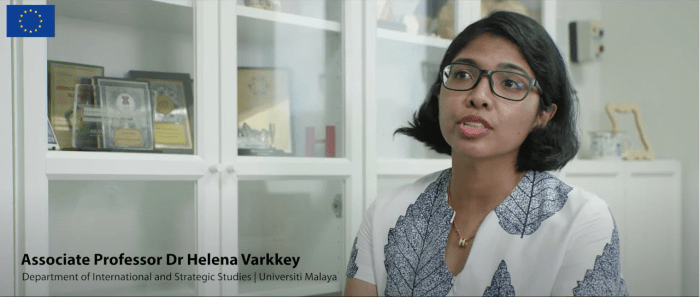
Media mention: (2024) COP29 Baku to outline more ambitious climate action strategies – Malaysian expert. News.AZ, 24 May.
Helena Varkkey was interviewed by News.AZ as their inaugural guest for a series on ‘COP29 Baku’, for which they interviewed prominent climate and environmental experts attending the COP29 summit in Baku, Azerbaijan.
Varkkey discussed the COP29 UN climate conference’s primary goals, emphasising the need for ambitious climate action plans, with a focus on climate financing and addressing loss and damage. She also highlighted the importance of COP conferences in fostering global climate efforts, identifying financial investment as the primary vehicle for scaling up innovative climate technologies that could enable and catalyse a just green transition.
Click here to read the full article.
Media mention: Tan L & Board J (2024) Climate Conversations – Why a complex problem like climate change needs multi-disciplinary expertise. Channel News Asia, 25 April.
David Taylor and Janice Lee were interviewed by Channel News Asia for a podcast episode in partnership with the inaugural IDEAS Festival.
Taylor and Lee first spoke about their academic backgrounds and current interests, and elaborated on their experiences working with large teams working on a wide range of issues. Next, they emphasised the interdisciplinary backgrounds of the researchers they collaborate with, as well as the interdisciplinary nature of the issues they work on, arguing that working across disciplines is essential to producing relevant scholarship that can be translated into real-world insights.
The pair concluded the interview sharing their passion for innovative pedagogies (such as interpretive dance!) for classroom learning and science communication, and their advocacy for why the Humanities and Social Sciences matter.
Click here to listen to the full podcast.

Short article: Lau et al (2024) Nature-based Carbon Credits in Southeast Asia: Where Intergenerational Justice Meets Second-order Climate Justice. ARIscope, 15 March.
Yingshan Lau, Lahiru Wijedasa, and Yunrui Ren, alongside Wei Mei Hum and Micah Ingalls, co-authored a short article for ARIscope on ‘Nature-based Carbon Credits in Southeast Asia: Where Intergenerational Justice Meets Second-order Climate Justice.’
First, they provide a brief overview of carbon markets and credits, arguing that ‘nature-based carbon projects are where intergenerational climate justice and second-order climate justice meet.’ Next, they situate the potential of carbon trading in Southeast Asia, and outline some potential climate justice-related concerns faced by nature-based carbon projects in the region.
The authors conclude by exploring how carbon markets can rise above these concerns to better facilitate climate justice, and highlight how more dialogue is needed between different stakeholders to understand the impact of nature-based carbon projects.
Click here to read the full short article.
Media mention: Tan R (2024) Indonesia is clearing vast peatlands to grow food. Climate costs are dire. Washington Post, 19 January.
David Taylor was interviewed by the Washington Post for an article documenting the environmental impacts of peatland cleaning in Indonesia.
Taylor drew on his decades of research looking at peatlands in Asia and Africa to estimate that ‘”To restore these vast areas of peat forest being destroyed will take years and huge investments in labor and funds,”… To do it on the timeline that global leaders have set for the world to achieve net-zero emissions? “Near impossible,” Taylor said.’
Click here to read the full article, including Taylor’s contributions.

Workshop: Workshop on Governing Carbon for Climate Change Mitigation and Adaptation: Challenges and Opportunities for Southeast Asia, ARI, NUS, 19 January 2024 (convened in a hybrid format).
The CGSEA team organised a workshop at the Asia Research Institute, National University of Singapore, on 19 May 2025, inviting seven project collaborators from across Southeast Asia and Europe to share preliminary findings of research undertaken through the grant, including literature reviews and preliminary fieldwork. Presenters shared interdisciplinary work that touched on the grant’s four work packages, exploring the governance dimensions of terrestrial forests, coastal and freshwater ecosystems, and peatlands and agricultural soils. Some presenters also provided insights from preliminary fieldwork undertaken in Laos and the Philippines, as well as insights from the recently-concluded COP28 in Abu Dhabi.

Opinion piece: Chenoli S, Varkkey H & Ooi J (2024) Reflections from academics on attending COP28 – Sheeba Chenoli, Helena Varkkey, and Jillian Ooi. Scoop, 9 January.
Helena Varkkey, alongside Sheeba Chenoli and Jillian Ooi, co-wrote an opinion piece for Scoop titled ‘Reflections from academics on attending COP28.’
The authors ‘share[d] firsthand experiences at COP28, offering unique insights into the complex world of climate negotiations.’ ‘Such opportunities give us the rare chance to be heard by UN officials, country delegates, and a whole range of stakeholders simultaneously’, reflected Varkkey and her colleagues. ‘We can receive instant feedback from like-minded researchers, get cutting-edge ideas for our future work, and network. It gave us plenty of food for thought that we could take home to feed into our consultations with policymakers and others.’
Varkkey also shared her experience serving as a panel speaker for ‘Reducing Global Methane Emissions: Imperatives, Opportunities, and Challenges’, a side event at COP28, organised by the Harvard Methane Initiative, where she shared findings from a recently completed project on the progress of methane emissions reductions in Malaysia.
Click here to read the full article.
2023
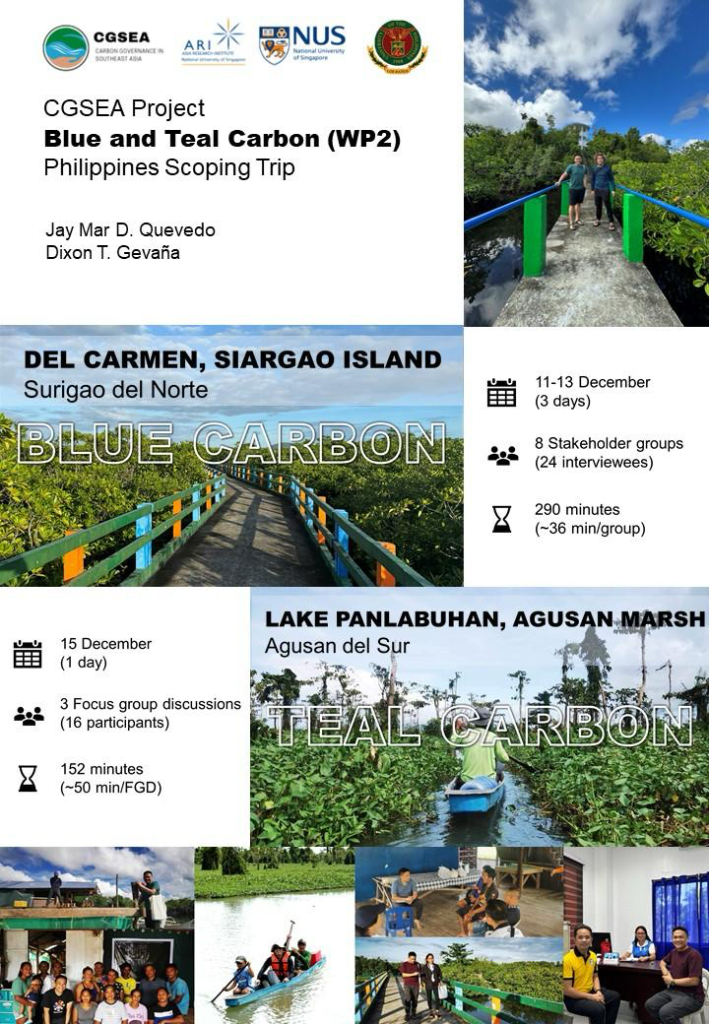
Fieldwork: Jay Quevedo and Dixon Gevaña undertook a research scoping trip to Del Carmen, the Philippines, from 11-15 December 2023.
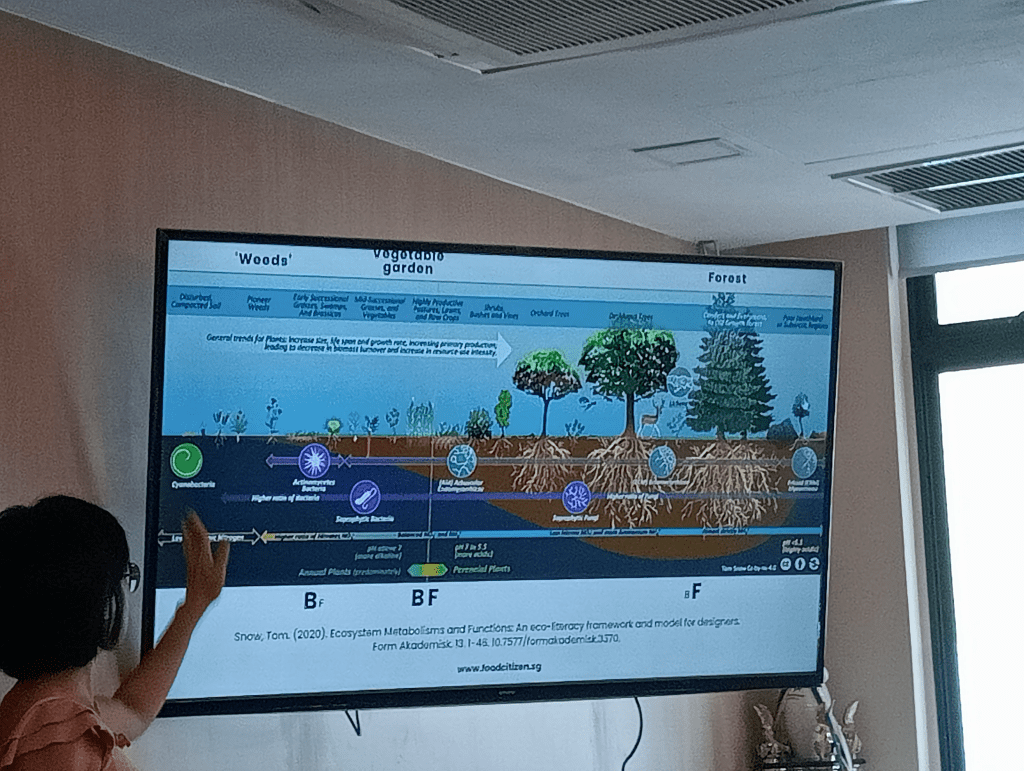
Event: Community Composting Workshop, Bukit Panjang Community Club, 21 November 2023. Organised by Food Citizen.
Michelle Miller and Wayne Rice attended a community composting workshop organised by Food Citizen. Facilitators presented on the theoretical and technical elements of effective composting practices, and led participants through a hands-on composting activity.
Event: An Eat-mersive Experience, Gardenhouse, Jurong Lake Gardens, 19 November 2023. Organised by Science Centre Singapore.
Wayne Rice attended an event on food sustainability and climate change presented by Science Centre Singapore, with support from the National Parks Board. The purpose of the event was to promote awareness on issues of food sustainability and climate change, and the importance of public participation in reducing wood wastes through organic composting. The event concluded with a tour of the edible gardens.
Click here to learn more about the event.

Event: Regional Workshop on ASEAN Peatland Management Strategy 2023-2030 and Way Forward, Bangkok, 14-15 November 2023. Organised by Environment Division, ASEAN Secretariat.
David Taylor was invited by the ASEAN Secretariat to chair a two-day regional workshop on ASEAN Peatland Management Strategy 2023-2030 and Way Forward. The workshop was organised by the Environment Division of the ASEAN Secretariat, and involved representatives of ASEAN Member States and other stakeholders working on peatland-related issues in the region.
The workshop, which was held to kick off the ASEAN Peatland Management Strategy (APMS) 2023-2030, was funded by the EU and Deutsche Gesellschaft für Internationale Zusammenarbeit (or simply GIZ) as part of Component 1 of Sustainable use of Peatland and Haze Mitigation in ASEAN (SUPA).
The first day was a closed-door event in which representatives of ASEAN Member States and the ASEAN Secretariat discussed the APMS 2023-2030 in the context of lessons learned from and new developments since its predecessor (APMS 2006-2020), and agreed an implementation road map to the end of 2025. The second day of the workshop involved representatives of ASEAN Member States and other stakeholders in sustainable peatland management, including the Global Environment Centre/ASEAN Investment Framework, SUPA-GIZ, International Fund for Agricultural Development, UN Food and Agriculture Organisation, PM Haze, and Roundtable on Sustainable Palm Oil. In addition to chairing the second day of the workshop, Taylor also presented on how universities such as the National University of Singapore can help facilitate implementation of the APMS 2023-2030.
Fieldwork: Miles Kenney-Lazar, Yingshan Lau, Sithong Thongmanivong, Robert Cole, Yunrui Ren, and Yuchuan Zhou undertook a research scoping trip to Vientiane, Laos, from 21-28 October 2023.

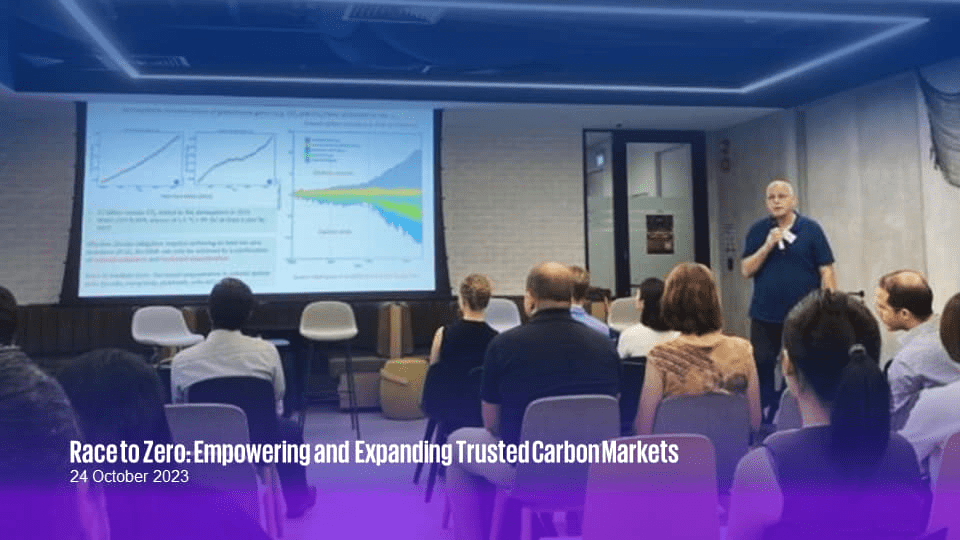
Presentation: Taylor D (2023) The challenge of reducing net carbon emissions through natural carbon sinks and associated carbon offsets. Race to Zero series, Organised by KPMG Business Foundry, Singapore, 24 October.
David Taylor was invited to present on ‘The challenge of reducing net carbon emissions through natural carbon sinks and associated carbon offsets’ at an evening talk for the Race to Zero series. The talk focused on the role of natural carbon sinks in attempts led by voluntary carbon markets to reduce net carbon emissions. The talk was followed by a lively panel discussion and Q&A session.
Workshop: Roundtable on Carbon Offsetting and Carbon Markets in Southeast Asia: What Role do they play in Climate Justice?, ARI, NUS, 9 October 2023 (convened in a hybrid format).
The CGSEA team organised a roundtable at the Asia Research Institute, National University of Singapore, on 9 October 2023. Yingshan Lau chaired the roundtable, which featured Wei Mei Hum from AirCarbon Exchange, Lahiru Wijedasa from Birdlife International, and Micah Ingalls from the Mekong Region Land Governance (MRLG) project.
The roundtable brought together practitioner-experts to contemplate how climate justice is considered in market-based environmental governance mechanisms in Southeast Asia. The speakers shared their views on how carbon offsetting, carbon markets and REDD+ project design consider social safeguards, environmental co-benefits and benefit-sharing, as well as on existing gaps and challenges that need to be addressed.
Opinion piece: Salvo A & Lee L (2023) How open data and gamification can make Singapore’s urban travel greener. The Business Times Weekend, 16 September.
Alberto Salvo, alongside Leonard Lee, co-wrote a piece for The Business Times Weekend on ‘How open data and gamification can make Singapore’s urban travel greener’.
The authors advocate for the use of open data and gamification in shaping consumers’ choices, arguing that a ‘comprehensive open data initiative centred on each person’s urban travel choices can help close [the] intention-action gap’ between a person’s desire, and their ability, to make ‘greener’ choices.
Click here to read the full article.
Media mention: (2023) ECR Journeys: A socio-cultural expedition into environmental governance. The Applied Ecologist, 9 August.
Wayne Rice was interviewed by The Applied Ecologist for their series highlighting early career ecologists from around the world.
Rice reflected on his academic and professional journey, the importance of interdisciplinary research being done by the CGSEA project, and the role models that guide his research philosophy.
Click here to read the full interview.
Workshop: Mini-workshop on Social Science and Remote Sensing of Nature-based Carbon Sinks in Southeast Asia, ARI, NUS, 7 August 2023. Co-organised with Cornell University.
The CGSEA team, in collaboration with Cornell University, organised a mini-workshop at the Asia Research Institute, National University of Singapore, on 7 August 2023, hosting participants from both institutions for discussions on the role of social science and remote sensing methodologies in the study of nature-based carbon sinks in Southeast Asia.


Short article: Varkkey H, Cole R & Kenney-Lazar M (2023) Shifting Regulatory Regimes of Agribusiness and Plantation Investments in Southeast Asa: From RSPO to ASEAN-RAI. ARIscope, 31 March.
Miles Kenney-Lazar, Helena Varkkey and Robert Cole co-wrote a short article for ARIscope exploring the ‘shifting regulatory regimes of agribusiness and plantation investments in Southeast Asia.’
The authors note that Southeast Asia, as ‘a hotspot for large-scale agribusiness and commodity crops, including palm oil, rubber, banana, maize, cassava, and sugarcane’, has seen the ‘conversion of millions of hectares of land since the 2000s’, causing wide-scale environmental degradation.
They argue that though voluntary disclosure regimes can be helpful in encouraging the adoption of sustainable practices by governments, corporations and smallholders, and thus in reducing the rate of environmental degradation, key challenges in the adoption of these practices remain.
Click here to read the full short article.
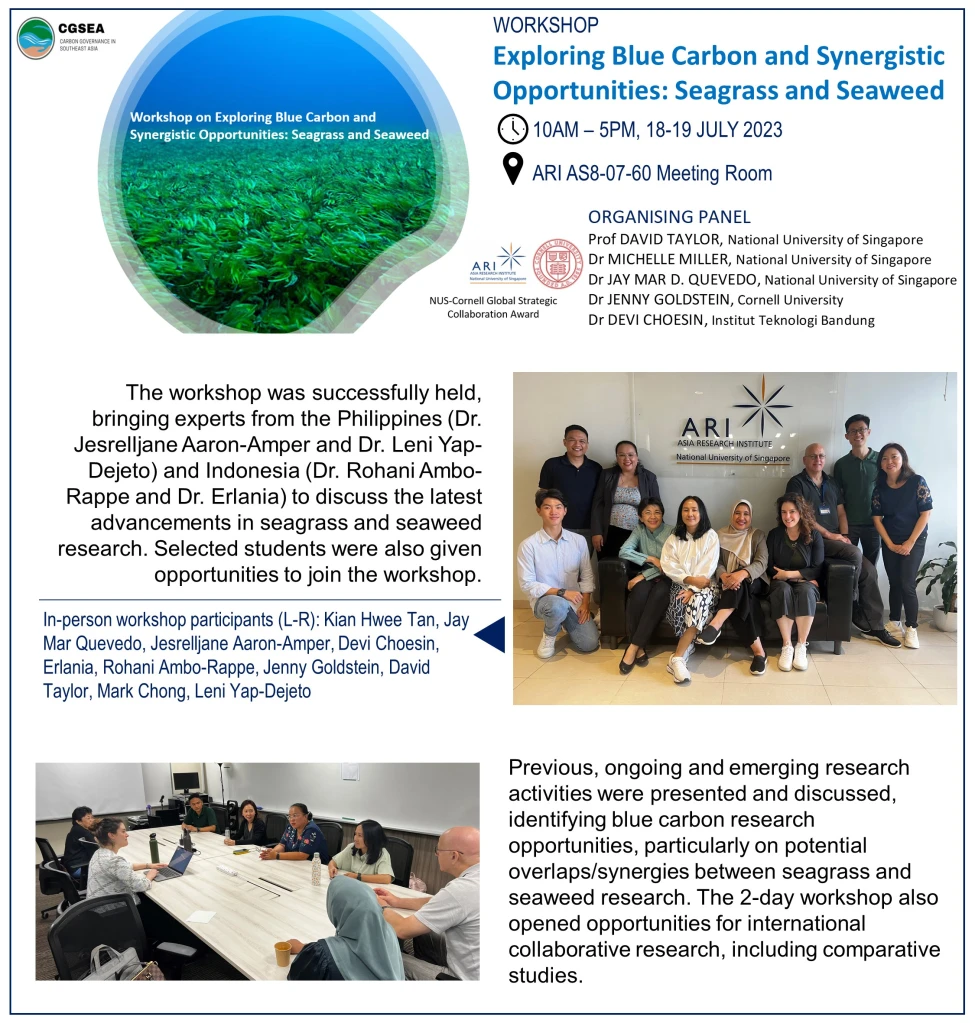
Workshop: Workshop on Exploring Blue Carbon and Synergistic Opportunities: Seagrass and Seaweed, ARI, NUS, 18-19 July 2023. Co-organised with Bandung Institute of Technology and Cornell University.
The CGSEA team, in collaboration with Bandung University of Technology and Cornell University, organised a mini-workshop at the Asia Research Institute, National University of Singapore, on 7 August 2023. Participants from all three institutions discussed the latest advancements in seagrass and seaweed research.
Media mention: Herridge T & Thirlaway K (2023) Rainforests: How to heal Earth’s Lungs. National History Museum, 18 July.
Helena Varkkey was one of four guests interviewed by the Natural History Museum for an episode on rainforests, part of their podcast series titled ‘Our Broken Planet’.
Varkkey spoke about the health risks posed by haze, and brought attention to how, in Southeast Asia, haze is usually caused by the intentional burning of peatlands. The discussion highlighted how rainforests can be a vital resource in combating the negative effects of haze specifically, and air pollution in general, ‘and how they are also great at sucking up excess carbon from the atmosphere’, large amounts of which are released when peatlands are burnt.
Click here to listen to the full podcast.
 Carbon Governance in Southeast Asia (CGSEA)